Part II - The Science of Shifting Worlds
Emotion: The Weather System of the Inner World
Emotion is the weather of the inner world: it signals model orientation, early evidence of change, and the tug-of-war between old and emerging selves.
Contents Chapter 5
A belief is a behavior waiting to happen.
I no longer trust the weather of midnight.
There are hours when the mind becomes a bad forecaster. A problem that looked manageable at 2 p.m. becomes a prophecy at 1 a.m. The unanswered message becomes abandonment. The unpaid bill becomes lifelong ruin. The tired body becomes proof that nothing will ever change. The future shrinks to the size of the feeling.
Morning does not fix every problem.
But morning often proves that the feeling was not the whole truth.
That is one of the first things to learn about emotion. It is real, but it is not always reliable as a map. It tells you something about your state, your interpretation, your history, your body, and your model. It does not automatically tell you the future.
The outer world is not always the first place change appears.
Sometimes the first evidence is relief.
You wake up and the problem is still there, but it no longer owns your breath. You think of the goal and feel less dread. You look at the work and feel a little more willingness. You imagine the conversation and sense that you might not collapse. Nothing measurable has changed yet, but something important has changed.
The atmosphere changed before the landscape did.
Do not dismiss that.
A little more ease.
A little more steadiness.
A little more honesty.
A little more energy.
A little less fascination with fear.
These are not imaginary. They are early weather patterns of a different model.
Emotion as weather, compass, and chemistry
Emotion is more than a feeling floating through the day.
Emotion is weather. It changes visibility.
Emotion is compass. It tells you which model you may be inhabiting.
Emotion is chemistry. It alters the body’s readiness for action, repair, connection, or defense.
Fear narrows. Gratitude opens. Shame collapses. Purpose organizes. Anger mobilizes. Peace restores. Love connects.
A frightened person does not see the same options as a steady person. A person in shame does not see the same future as someone who still has self-respect. An exhausted person does not evaluate opportunity the same way as a rested person.
Call that biology, not weakness.
Your state changes your sight.
This is why wellness is not decoration in a success book. Wellness determines which worlds are visible to you. Sleep changes the world. Breath changes the world. Movement changes the world. Food changes the world. Human connection changes the world. Silence changes the world.
The mind does not model reality in isolation. It models reality through a body.
When the body is chronically stressed, the forecast becomes threat-heavy. When the body is nourished and regulated, the model becomes more spacious. Many frightening thoughts become less convincing after sleep, food, walking, or one honest conversation.
Do not believe every world you see when your body is depleted.
Sometimes the world is not ending.
Sometimes you need water, rest, breath, sunlight, and a better sentence.
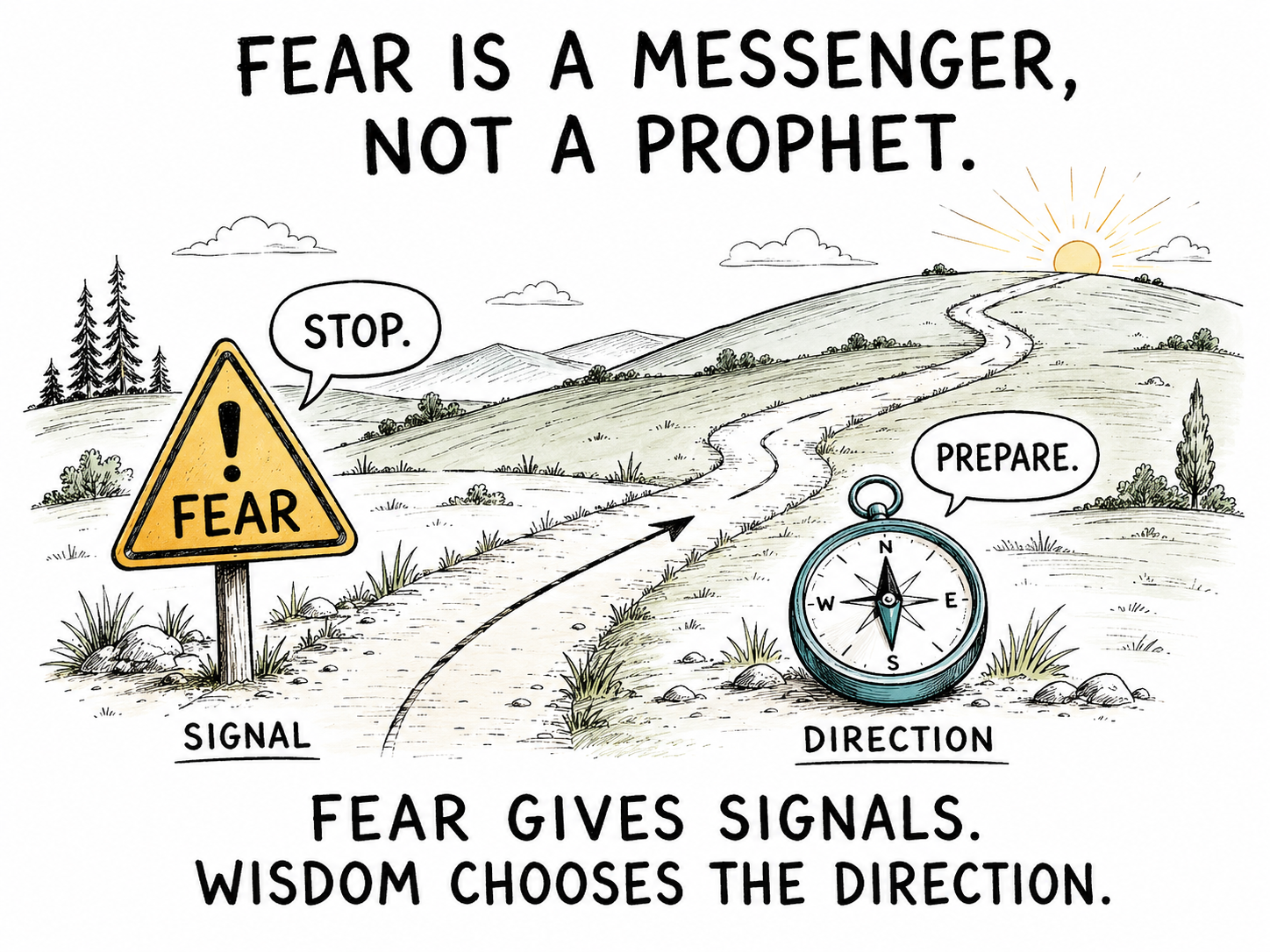
Do not ask fear to write the prophecy
Fear is fast.
That is part of its intelligence. We want fear when there is a real cliff, real fire, real betrayal, real danger. Fear notices certain threats before pride has finished writing a speech about how calm it is.
But fear is a poor prophet.
Fear looks at uncertainty and calls it doom. Fear looks at silence and calls it rejection. Fear looks at difficulty and calls it impossibility. Fear looks at growth and calls it risk. Fear looks at visibility and calls it humiliation.
If you ask fear to describe the future, it will usually write a horror story using fragments of your past.
So listen to fear, but do not hand it the pen.
Let fear speak as a messenger.
Do not let fear govern as king.
A useful practice is to say:
“Thank you, fear. What are you trying to protect?”
Then ask:
“What does wisdom see that fear cannot see?”
This creates a gap. Inside that gap, the world can shift.
The old model says, “I am afraid, therefore I should stop.”
The better model says, “I am afraid, therefore something matters. Now let me bring wisdom, preparation, and breath to what matters.”
Fear becomes fuel when it is no longer allowed to become fate.
State before strategy
State comes before strategy more often than proud minds want to admit.
There are problems you cannot think clearly about from inside panic. There are conversations you cannot enter wisely from inside shame. There are opportunities you cannot evaluate from inside exhaustion. The first move is not always a better plan. Sometimes the first move is a better state.
This does not make you fragile. It makes you human. The body is not a nuisance interrupting consciousness. The body is one of the instruments through which consciousness reads the world.
Before you ask, “What should I do with my life?” ask, “What state am I asking from?”
Before you trust the prophecy of fear, ask whether the prophet has slept.
Before you call the future impossible, ask whether the nervous system is simply flooded.
I have had to learn this the hard way. There are questions I am not allowed to answer when I am depleted. I can write them down. I can respect them. I can promise to return. But I do not let the most tired version of me hold court over the rest of my life.
The world you see from depletion is not always the world available from regulation.
Joy as method
The old success model often makes excellence look grim.
The jaw must tighten. The face must harden. The dream must become a burden. The person must prove seriousness by becoming less alive.
But some performers remind us that joy can be part of the method, not a prize postponed until after the method works. Carlos Alcaraz gives a vivid public example. By his early twenties, he had already become a former World No. 1 and a major champion on hard, grass, and clay courts. The trophy case matters less here than the visible operating system: speed, creativity, improvisation, elastic courage, and a fierce playfulness that keeps options open under pressure.
Joy does not make the task easy.
A five-set match is still suffering. Clay still punishes impatience. Grass still asks a different timing from the body. A great opponent still takes away your favorite answers and forces you to invent better ones. But joy changes the nervous system’s relationship to the difficulty. It keeps the player from shrinking the world into fear alone.
Fear asks, “How do I avoid losing?”
Joy asks, “What can I create inside this point?”
That difference matters.
In your life, joy may not look like tennis. It may look like curiosity while building a business, humor during a hard training season, music while cleaning the room, play inside a complicated project, warmth in a conversation that could become defensive, or the private satisfaction of practicing a craft before anyone applauds.
Do not misunderstand this. Joy is not denial. It is not pretending the score does not matter. It is not floating above responsibility. Real joy can coexist with discipline, grief, fatigue, ambition, and pressure. Sometimes joy is simply the state in which your intelligence becomes less cramped.
If you have been trying to pressure yourself into the next world, pause here.
Ask whether the model itself is exhausting you. Ask whether your dream has been wrapped in a mood that makes it harder to reach. Ask whether the next level needs more violence from you, or more aliveness.
The question is not just, “What do I want to achieve?”
The question is also, “What state allows me to bring my best intelligence to the attempt?”
For some people, the missing ingredient is not pressure. They have plenty. The missing ingredient is permission to bring delight back into the work. A lighter grip. A steadier breath. A return to why the dream mattered before it became a performance.
The ideal world is not the one where you finally achieve enough to deserve joy.
The ideal world is the one where joy helps you achieve without losing yourself.
Crossing the emotional border
Every new world makes you a beginner again.
That is why transformation often feels embarrassing. The successful person must become a student. The proud person must become teachable. The old identity must tolerate looking foolish for a while.
Feeling clumsy is not proof that you are failing. It is proof that you are entering territory where the old self is no longer in command.
Emotion is data, not command.
Listen to the weather.
Do not hand it the government.
Practice: Emotional Weather Report
For one week, write a short emotional weather report once per day.
Use this form:
- Current weather:
- Body evidence:
- Story attached to it:
- Model it may come from:
- What fear is trying to protect:
- What wisdom sees that fear cannot:
- One state shift I can make now:
- One action I will take after the state shift:
Do not demand joy. Ask for one degree more room.
The practice produces a record. By the end of the week, you should know which weather patterns keep visiting, what they try to protect, and which state shifts actually help.
Let weather inform, not rule
The weather will change. The chosen world is strengthened when you can feel the weather without letting it choose the road.
Ask fear what it is protecting. Ask wisdom what fear cannot see. Ask the body what state would make the next direct action available. Then move one degree. If you can shift state without denying emotion, you have begun to reclaim the climate of the inner world.