Part I - The Model-Making Mind
Parallel Worlds as Competing Models
Parallel worlds are competing models of the same moment, and every small choice is a doorway into one trajectory or another.
Contents Chapter 2
Your attention is a vote for the world you are strengthening.
I have learned to respect the small hinge.
Sometimes the hinge is opening the bank app.
Nothing mystical. No lightning. Just thumb, screen, balance.
The old model wants fog.
Do not look yet.
You already know it is bad.
Looking will only ruin the day.
Another model is also available, but it is quieter and less entertaining. It says:
Open it.
Learn the number.
One number is easier to handle than a cloud of dread.
Same phone. Same room. Two possible worlds.
Every decision is a doorway, but not every doorway announces itself. Most doors look like almost nothing: a thumb on an app, a sentence you could speak differently, a thought interrupted before it becomes identity, a walk instead of another hour of despair, a page written instead of another promise delayed.
The change may take thirty seconds. Open the account. Write the number. Choose the next payment, phone call, or useful question. The old model wanted a mood. The better model asks for data.
The defeated world and the disciplined world may differ at first by only five minutes. Five minutes of movement. Five minutes of planning. Five minutes of silence before speaking. Five minutes of opening the bank app instead of letting dread narrate the numbers from another room.
Five minutes does not look like a new life.
Repeated honestly, it becomes one.
The world is not outside you in the way you think
We speak of the world as though it were completely outside us.
The job is outside.
The relationship is outside.
The bank account is outside.
The body is outside.
The opportunity is outside.
The problem is outside.
In one ordinary sense, this is true. The chair is not your thought. The weather does not ask permission from your mood. The body has biology. Money has arithmetic. Other people have wills of their own.
But inside and outside are never fully separate.
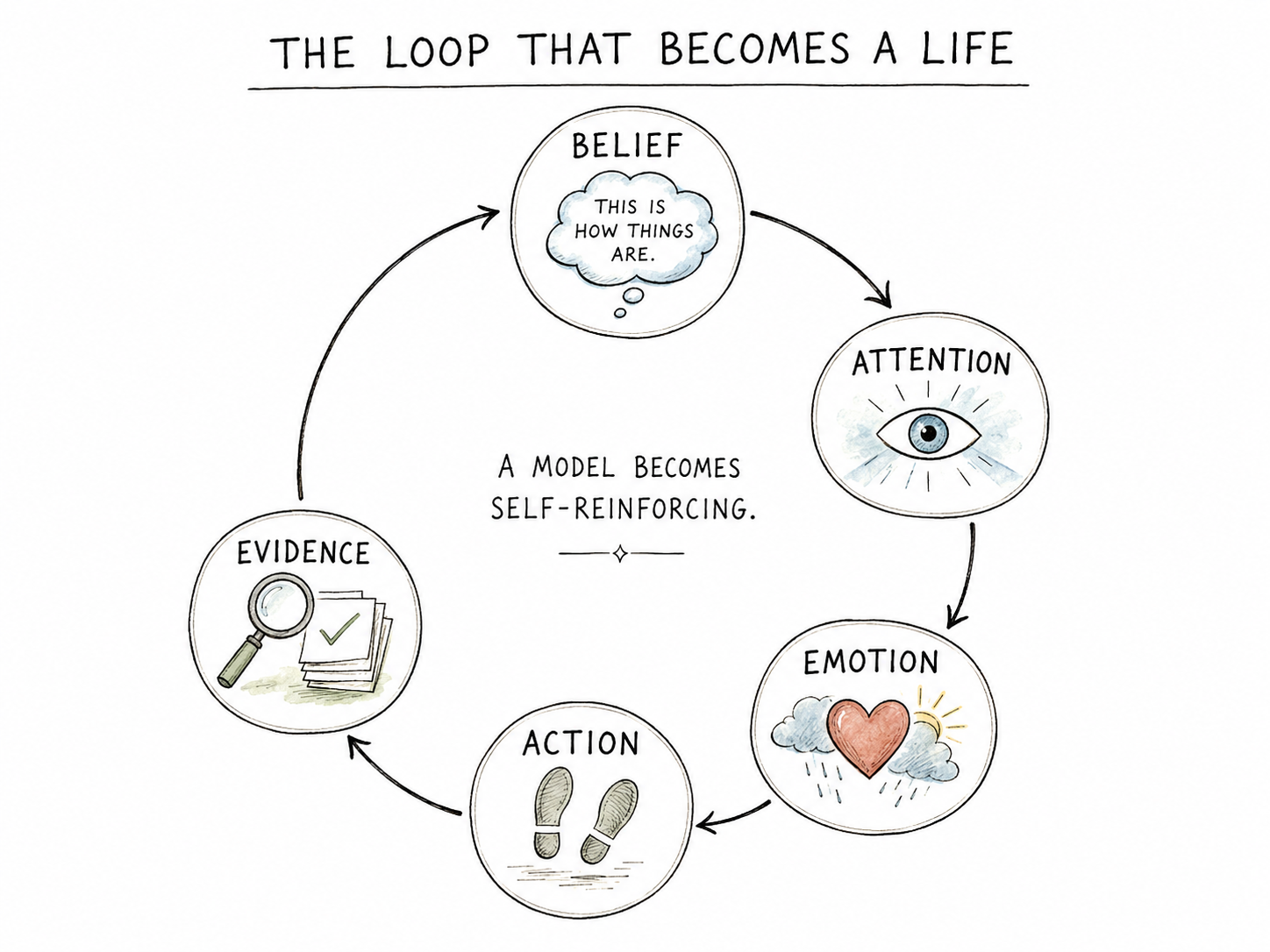
The outer world enters you through perception. The inner world leaves you through behavior. What you believe changes what you notice. What you notice changes what you feel. What you feel changes what you attempt. What you attempt changes the feedback you receive from reality. Then the feedback returns inside you and becomes belief again.
Inside becomes outside.
Outside becomes inside.
A human life is not a sealed mind staring at a dead universe. It is a loop. A conversation. A living exchange.
That is why changing the inner model matters. Not because the outer world is imaginary, but because the outer world you can access is shaped by the inner equipment you bring to it.
If you enter a room expecting hostility, your face may arrive before your words do. Your eyes scan. Your shoulders guard. Your voice tightens. Other people feel the tension and respond cautiously. Then the old model points at their caution and says, “See? Cold room.”
Maybe the room was cold.
Maybe you brought winter with you.
Usually life is not tidy enough to separate those perfectly.
That is why the loop matters.
The outside answers the inside
A model is not private for long.
At first, it lives quietly inside the mind. It is a belief, an expectation, a familiar emotional weather. Then it leaks into posture, language, timing, attention, appetite, ambition, and choice.
If you believe you are unwanted, you may speak less. If you speak less, fewer people know you. If fewer people know you, fewer invitations come. If fewer invitations come, the old belief says, “I told you.”
If you believe you can learn, you ask more questions. If you ask more questions, you get more information. If you get more information, you improve. If you improve, the belief says, “Keep going.”
Belief becomes behavior.
Behavior becomes environment.
Environment becomes evidence.
Evidence becomes belief.
That is the loop.
The question is not whether you are inside such a loop. You are.
The question is whether the loop is imprisoning you or educating you.
To shift worlds, you interrupt the loop at the most accessible point. Sometimes that point is thought. Sometimes it is language. Sometimes it is breath. Sometimes it is the next action. Sometimes it is the people you allow to define normal. Sometimes it is sleep, food, movement, and sunlight.
A new trajectory does not require you to control everything.
It requires you to change the next link in the loop.
The loop is where freedom begins
Freedom begins when you stop treating the loop as fate.
A loop is not a life sentence. It is a pattern with entry points. If you cannot change the whole environment today, you may be able to change the sentence you bring into it. If you cannot change the sentence yet, you may be able to change the breath beneath it. If you cannot change the breath immediately, you may be able to change the next behavior by one inch.
This is practical leverage. The inherited loop survives by convincing you that all links must change at once or none can change at all. A better loop begins when you choose one link and interrupt it with intelligence.
Do not underestimate one altered link.
A calmer tone can change a conversation.
One hour of sleep can change the forecast of the morning.
One truthful page can change the shape of a project.
One honest boundary can change the climate of a relationship.
One completed action can change what the self believes is possible.
When you change one link, you are not pretending the chain is gone. You are proving the chain is not god.
The cost of standing still
Standing still is not the same as staying safe.
The world keeps moving. Time keeps moving. The body keeps aging. Opportunities open and close. Relationships evolve. Skills decay when unused. Courage weakens when never asked to act. The old model deepens its roots each time it goes unchallenged.
There is no true stasis.
There is movement toward the chosen world, or there is drift toward the inherited one.
The smallest forward motion matters. One page. One walk. One honest conversation. One repaired habit. One debt paid down. One morning where you do not hand your mind over to the old fear.
These are not small in the invisible architecture of a life.
They are votes against decay.
A Three-World Simulation
One situation can produce three worlds.
Situation: You need to send a difficult email.
Old world:
“If I say the wrong thing, this will become a disaster.”
Body: tight chest, fast scanning, delayed action.
Likely behavior: reread, postpone, resent the person for needing a reply.
Probable result: delay creates more pressure.
Fear world:
“I need to protect myself, so I will send something sharp first.”
Body: heat, jaw tension, speed.
Likely behavior: write from injury and call it honesty.
Probable result: the email becomes a new problem.
Chosen world:
“I can be clear without performing innocence or attack.”
Body: slower breath, feet on floor, one draft before sending.
Likely behavior: write the truth, remove the performance, send the next honest version.
Probable result: more dignity, more information, less fog.
Treat this as rehearsal before the old loop grabs the microphone.
Practice: The Inside/Outside Loop
Choose one repeating life pattern.
Examples:
“I always feel ignored.”
“I never have enough money.”
“I start projects but do not finish.”
“I avoid conflict until it explodes.”
“I want to be healthy but keep returning to old habits.”
Now write the loop:
- Inner model: What do I believe or expect?
- Attention: What do I notice because of this belief?
- Emotion: What feeling does this produce?
- Body: What posture, breath, or physical state appears?
- Behavior: What do I do or avoid doing?
- Outer feedback: What happens as a result?
- Reinforced belief: How does the feedback strengthen the original model?
Then write one link you will alter today:
“Today I will interrupt the loop at ______ by ______.”
Make the interruption visible. Send the email. Walk for five minutes. Ask the direct question. Put the phone in another room. Open the account. Say the boundary in one sentence. Record what changes, even if the change is only one inch.
Cross one link today
Parallel worlds do not begin as science-fiction spectacles. They begin as competing interpretations inside the same moment.
The inherited loop asks you to repeat everything: the old sentence, the old focus, the old emotion, the old behavior, the old evidence. The better path usually asks for something smaller and braver.
Change one link.
Enter the room with one different expectation. Answer the fear with one truer sentence. Take one action before the old identity has finished making its case.
A world is crossed one link at a time.