Opening
The World You Live In Is the World You Model
The opening argument: reality is partly lived through models, the present is data rather than destiny, and a new world begins as an inner model before it becomes outer evidence.
Contents Introduction
I have learned not to trust the first world my mind hands me.
There are mornings when I can feel life shrink before I have done anything wrong: one email I keep rereading, one number in the bank app, one tightness in the body I would rather ignore. Nothing theatrical has happened. No collapse. No lightning. Just the familiar pressure of a life asking to be interpreted.
But interpretation is never neutral.
One sentence arrives first: This is a problem. Then another: This means something about me. Then the room changes. I read tone into punctuation. I treat a number as a forecast. I start negotiating with a future that has not even arrived.
The strange part is that nothing outside me has changed yet.
The world has shifted because the model has shifted.
That is where this book begins. Not with the fantasy that thoughts magically control reality. They do not. Reality has weight. Bills exist. Bodies speak. People disappoint us. Systems can be unfair. A diagnosis is not erased by a better sentence.
But the sentence matters.
The model matters.
The first interpretation matters because it decides how you enter the next minute. Do you enter it as a defendant, a student, a builder, a witness, a child waiting to be punished, or a person who can tell the truth and still move?
Shifting worlds is the practice of refusing to let the first model become the final world.
A contract with reality
This book will not ask you to pretend the outer world has no force.
It will not tell a sick person that pain is a failure of imagination. It will not tell a grieving person to upgrade the vibe. It will not tell someone under financial pressure that prices, wages, rent, health, family obligations, or unfair systems are imaginary.
That kind of advice is not wisdom. It is cruelty with a soft voice.
The claim here is humbler and more useful: inside real conditions, the model you practice changes what you notice, what you attempt, how you recover, how honestly you look, which help you seek, and which future receives more evidence.
You do not control everything.
But wherever agency remains, the model you practice still matters.
Change your inner model, change your outer world
Shifting Worlds grows out of my earlier work with parallel-world thinking: the idea that a life contains many possible trajectories, and that we move toward one of them through attention, emotion, language, action, and identity. This book is more mechanical, more practical, and, in a useful way, less mystical. It asks a direct question:
What is the operating model that keeps producing your current world?
That heading is easy to misuse, so let me make it plain: changing the inner model does not mean commanding the outer world. It means changing the instrument you bring to the outer world. You still have to deal with the facts. You just stop letting the first interpretation act like the final fact.
Not your mood. Not your slogan. Not the sentence you repeat when you are trying to force yourself into optimism. The model. The little simulator. The set of assumptions that tells your mind what is possible before you have even tested the day.
If your model says, “People like me do not succeed,” success will feel foreign even when opportunity appears. If your model says, “Wellness means laziness,” rest will feel like guilt. If your model says, “Pressure means danger,” your body will treat every challenge as an attack. If your model says, “Money is proof of corruption,” part of you may push wealth away while another part claims to want it.
The model does not need to be true to be powerful. It only needs to be repeated.
That is why bad models can feel like facts. They have rehearsed themselves inside you. They have gathered evidence, ignored counter-evidence, trained your posture, selected your memories, and shaped your expectations. By the time you call something “reality,” your mind may already have edited the file.
This book is a guide to opening the file.
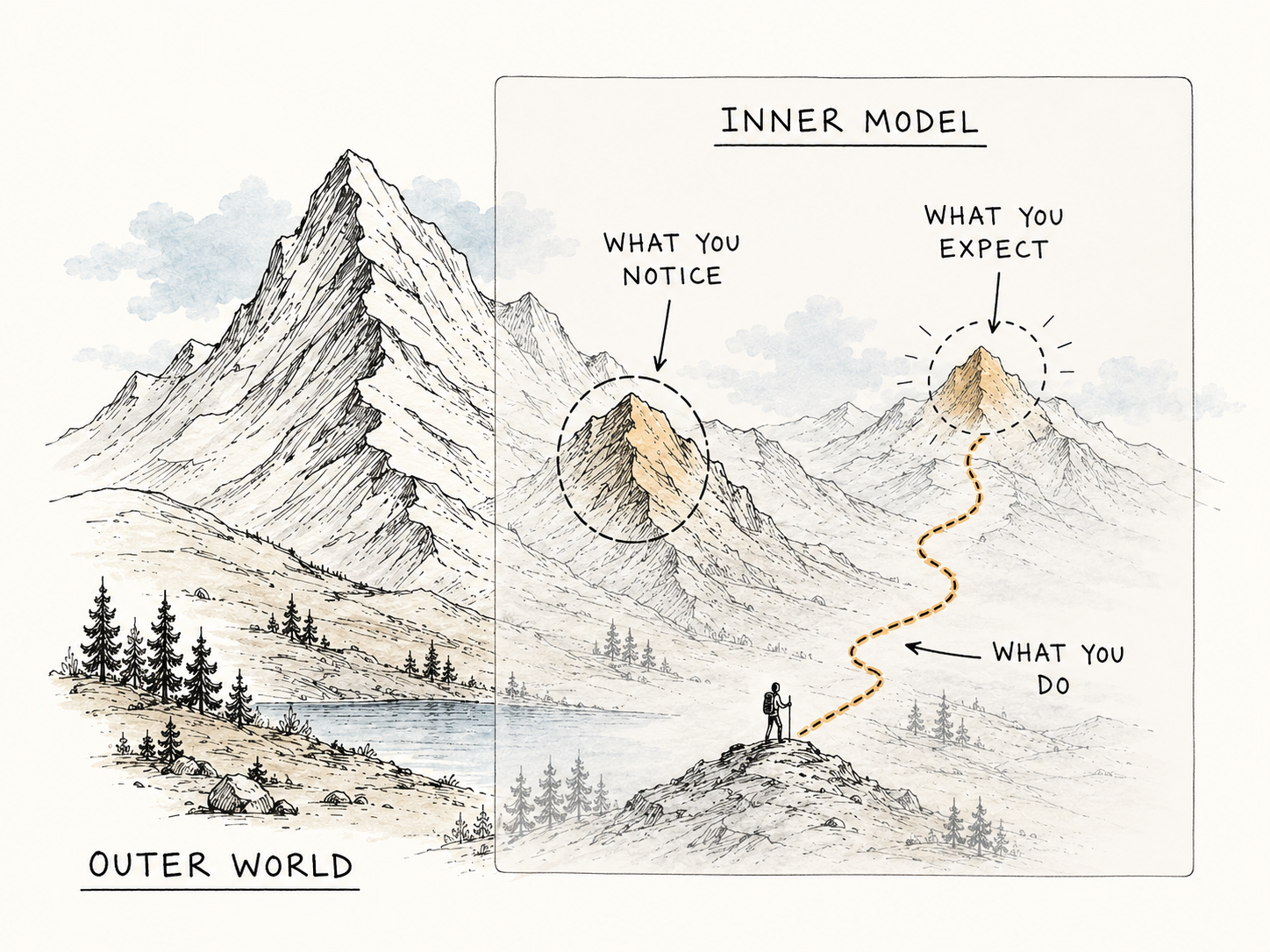
The sequence of a world
A world is built by sequence.
Thought becomes interpretation. Interpretation becomes emotion. Emotion becomes body state. Body state changes perception. Perception selects evidence. Evidence reinforces identity. Identity drives action. Action produces outcomes. Outcomes return to the model and say, “See? I told you.”
The loop can imprison you. It can also liberate you.
If the model is “I always fail under pressure,” pressure becomes threat. Threat creates tension. Tension creates overthinking or avoidance. Avoidance produces weak evidence. Weak evidence returns to the model and strengthens it.
But if the model is “Pressure is energy looking for direction,” the same physical arousal becomes usable. Your heart is not betraying you. It is preparing you. The moment has not changed, but the available action has changed.
That is not shallow positive thinking.
That is model engineering.
Success without self-destruction
Many people try to change their lives by demanding more force from an unchanged model. They push harder while still believing they are doomed. They chase achievement while treating the body like an inconvenience. They repeat affirmations while their daily language continues to describe life as a prison. They visualize the result but never rehearse the identity, systems, and recovery patterns that would make the result livable.
That kind of ambition burns people down.
The goal here is different: success without self-destruction; wellness without passivity; ambition with inner coherence.
Success matters. Direction matters. Discipline matters. But you cannot build a new world with a nervous system that is always at war with itself. The model must include the body. It must include recovery. It must include language. It must include relationships. It must include the way you interpret failure, money, attention, stress, conflict, and possibility.
The world you are trying to enter must be supported by the person you are becoming.
How to read this book
Read this book as a practical laboratory.
Do not rush to believe everything. Test it. Do not use the idea of “shifting worlds” to escape responsibility. Use it to take more precise responsibility. Do not pretend the outer world has no force. It does. But also do not surrender your inner simulator to the first fear, old story, or inherited script that walks into the room.
The method is simple enough to begin today and deep enough to return to for years: name the model, test it, keep what works, discard what weakens, build a better model, and install it through evidence.
Most people wait for readiness as though readiness were a gate someone else must open. But readiness is often not the beginning of movement. Readiness is the result of movement.
The first version of anything meaningful is usually crude. The first plan is incomplete. The first attempt is embarrassing. The first sentence does not yet know the book it belongs to. The first workout does not yet know the body it is building. The first act of courage does not yet feel like courage. It feels like awkwardness with a pulse.
This is not a defect in the process. This is the process.
The old world demands that you be impressive before you begin. The new world asks only that you begin honestly.
You do not merely move through the world.
You move through the world your mind has made available to you.
And if that is true, then there is a practical question waiting at the threshold of every day:
What world am I practicing now?
The present is data, not destiny
The present moment has a strange authority over the human mind.
Because it is visible, we believe it is final. Because it is measurable, we believe it is superior to imagination. Because it has already happened, we give it the status of truth. We look at the bank account, the body, the relationship, the diagnosis, the career, the room, the calendar, the evidence, and we say, “This is my reality.”
Yes.
But not the whole of it.
The present is real, but it is not complete. Some of what you see is the surface expression of previous patterns, previous decisions, previous interpretations, previous habits, and previous models. Some of it is circumstance, biology, timing, injustice, other people’s choices, or plain bad luck. Either way, it deserves your attention, but not your worship. It deserves your honesty, but not your surrender.
The present tells you where you are standing.
It does not tell you where you are allowed to go.
When you confuse the present with destiny, evidence becomes a guard at the door. I know that feeling. A number on a screen can start sounding like a judge. A tired body can start sounding like a prophecy. But when you treat the present as data, the guard becomes a messenger. The first posture says, “This is how things are.” The second says, “This is what can be read, faced, and worked with.”
And once you see the model, you can begin to shift it.
You do not deny the present. You study it. You listen to it. You extract its information. Then you ask the great shifting question:
“What model would produce the world I actually want to live in?”
That is where the doorway appears.
A problem is loud because it has furniture. Bills. Symptoms. Conversations. A history. It can point to itself and say, “Look. I am real.”
A solution is quieter at first.
It begins as a possibility. Then a thought. Then a feeling. Then a sentence. Then a small action. Then a new pattern. Then evidence. Then momentum. Then what once seemed impossible becomes ordinary.
This is why a solution-world must be protected in its early stages. It is easy to crush a new world by demanding that it look fully grown before it has roots.
The old world has proof because it has been practiced.
The new world needs practice before it has proof.
Do not ask a seed to provide shade on the day it is planted. Do not ask a new identity to produce a lifetime of evidence in its first hour. Give the better model attention, language, breath, body, choice, and loyalty long enough to gather a receipt.
The solution-world begins as a direction.
Turn toward it.
Then keep turning.
Opening practice: Name the world
Choose one area of life: health, money, career, relationships, creativity, learning, leadership, or peace.
Write three sentences:
- The world I currently believe I am in is…
- The rules of this world seem to be…
- The version of me who lives here is…
Then write one more:
- A better model of this world would be…
Now choose one visible receipt for the next twenty-four hours: a sent message, a ten-minute effort, a walk logged, a sentence rewritten, a number looked at without self-attack, a boundary spoken, a page opened, or a small promise kept.
Do not make it grand. Make it usable. A better model is not the most flattering story. It is the story that helps you see more accurately, act more courageously, recover more quickly, and become more aligned with the life you intend to build.