Part I - The Model-Making Mind
The Little Machine in the Head
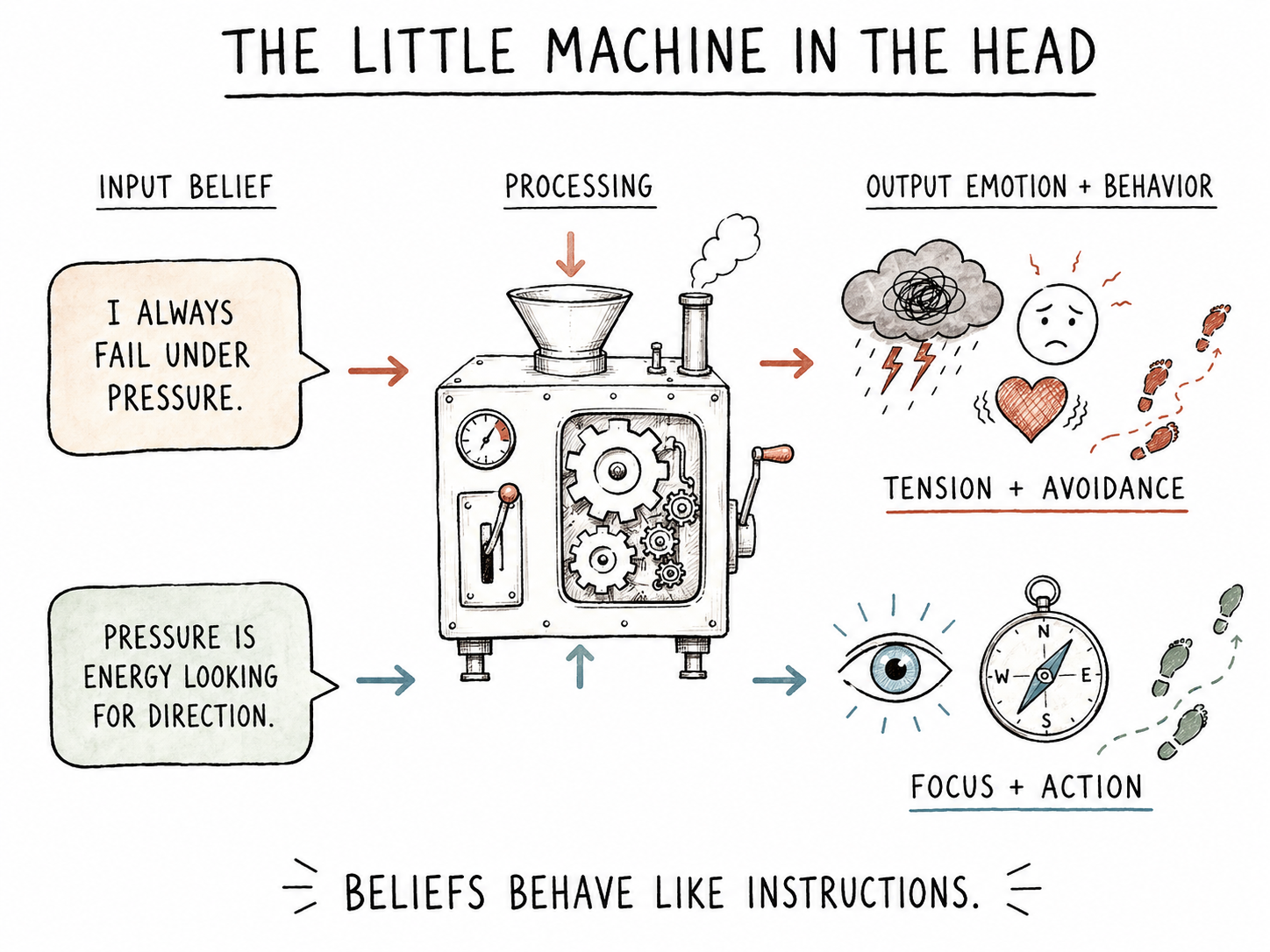
Beliefs act as instructions to the whole organism; change the input and the nervous system, attention, posture, and behavior begin producing different outputs.
Contents Chapter 3
The future does not merely arrive. It is rehearsed.
I have walked into conversations already losing.
No one had said anything yet. Nothing had technically happened. But the machine had started early. My breath was shallow. My shoulders were up. My mind was rehearsing the accusation I expected to hear. By the time the real conversation began, I was not fully in the room. I was in the rehearsal.
That is how the little machine works.
It does not wait for reality to finish speaking. It takes an input and starts producing a world.
Input: “I am not good under pressure.”
The nervous system hears danger. The breath shortens. The eyes scan for disapproval. The hands tighten. The voice loses steadiness. The mind forgets what it knows. The person performs worse than they could have performed, and the belief says, “See? I told you.”
Now change the input.
“Pressure is energy asking for direction.”
The same body receives a different instruction. The heartbeat may still be loud. The hands may still have energy in them. But the meaning changes. Breath becomes a tool. Alertness becomes preparation. The mind does not say, “Escape.” It says, “Aim.”
This is why a belief is more than a sentence. It is an instruction.
Your models are instructions to the whole organism.
Change the instruction, and you begin changing the output.
Momentum is real
Thoughts gain momentum.
That is not just a metaphor. Anyone who has spiraled at night knows the body of it. One thought becomes ten. Ten become a weather system. The phone comes out. The search begins. The memory is reinterpreted. The future gets dragged into court. Suddenly the person is not solving a problem; they are feeding a machine.
You cannot always stop that instantly.
This is where people become cruel to themselves. They feel fear and then attack themselves for feeling fear. They feel doubt and then add shame to the doubt. They feel anger and then become angry that they are angry.
Now there are two problems.
The first shift is not always from despair to joy. Sometimes that jump is too far. Sometimes the first shift is from despair to a little less despair. From panic to breathing. From rage to honesty. From helplessness to one useful action. From “everything is ruined” to “I do not yet know what to do.”
That is not failure.
That is steering.
A pilot does not curse the plane because it cannot turn ninety degrees in one inch of sky. A sailor does not hate the boat because wind and water have momentum. A wise person respects momentum and begins adjusting the angle.
Relief is a valid first destination.
Reach for the thought that gives the nervous system one more inch of room.
Then another.
Then another.
This is how the mind changes direction without violence against itself.
Spotlight and floodlight inside the machine
The little machine uses attention in two ways.
The spotlight is the narrow beam. It locks onto a target, reads the sentence, studies the number, watches the face, aims at the finish line. The spotlight is necessary. Without it, there is no precision.
The floodlight is wider awareness. It senses the room. It reads atmosphere. It notices what the spotlight misses. It feels timing, context, tone, energy, pattern. It is why a conversation can feel wrong before you know why. It is why an idea arrives while showering, walking, resting, or staring at nothing useful.
Modern life overtrains the spotlight and neglects the floodlight.
Screens train us to narrow. Metrics train us to narrow. Notifications train us to narrow. A person can spend an entire day handling messages, numbers, tasks, feeds, and threats, then wonder why the deeper self has gone quiet.
The spotlight becomes exhausted because it thinks it must manage the whole world alone.
But the deeper mind is larger than the task list.
This matters because some inputs can only be changed when you widen enough to notice them. If you are locked onto the argument, you may miss the exhaustion beneath it. If you are locked onto the number, you may miss the shame story attached to it. If you are locked onto the deadline, you may miss the fact that the plan was never actually designed.
In practice, the spotlight finds the active input: “I am about to fail,” “They are against me,” “This is too much,” “I have already ruined it.”
The floodlight checks the rest of the room. What is my body doing? What is the actual evidence? What else is available besides this one hot sentence? Is there a person in front of me, a floor beneath me, a next action small enough to take?
The little machine needs both. Spotlight without floodlight becomes obsession. Floodlight without spotlight becomes drift.
The body remembers the route
The deeper system trusts repetition more than speeches.
This is annoying, but fair.
You cannot give the body one beautiful sentence and expect it to forget years of rehearsal. The old pattern has routes. It knows the shortcut from criticism to collapse, from uncertainty to control, from fatigue to despair, from desire to self-sabotage.
A useful belief must travel downward. It must leave the page and enter the morning. It must leave the intention and enter the calendar. It must leave the vision and enter posture, breath, speech, environment, and repetition.
The little machine becomes wiser when the whole organism receives new evidence often enough to stop treating the new pattern as a stranger.
Reprogramming the machine
The little machine does not change because you yell at it.
It changes because you feed it better inputs and let behavior confirm them.
A sentence becomes a cue. A cue becomes a body state. A body state makes an action more likely. The action creates evidence. The evidence becomes easier to believe the next time.
This is why the first replacement input must be believable enough to practice. Do not demand that the machine leap from despair to triumph. Give it the next honest instruction.
Bad input:
“If I cannot do this perfectly, I should not start.”
Better input:
“I can make a rough first version and improve it with evidence.”
Bad input:
“This feeling means I am failing.”
Better input:
“This feeling means the system is activated. I can slow down and choose the next unit.”
Bad input:
“They did not reply because I do not matter.”
Better input:
“I do not have enough information yet. I can ask, wait, or move my attention back to what is mine to do.”
The better input should not be decorative. It should change breath, posture, attention, or action. If it does not change anything, it is not yet an instruction. It is just a sentence wearing a nice jacket.
Practice: Change the Input
Choose one output you dislike: panic, avoidance, resentment, collapse, harsh speech, doomscrolling, delay, or the sudden urge to quit.
Write the sequence:
- Trigger: What happened?
- Old input: What sentence, image, memory, or body state started the machine?
- Body output: What changed in breath, posture, face, stomach, hands, or energy?
- Attention output: What did you start noticing?
- Behavior output: What did you do or avoid?
- Evidence created: How did the result strengthen the old input?
Now choose one replacement input.
It must be:
- True enough to believe.
- Short enough to remember.
- Physical enough to change something in the body.
- Actionable enough to test within twenty-four hours.
Before you test it, do one embodied rep:
- Name the old input out loud or on paper.
- Locate it in the body.
- Change one physical condition: feet flat, jaw unclenched, shoulders lowered, exhale lengthened, eyes lifted from the screen.
- Speak the replacement input once.
- Take one small action.
- Record the before-and-after body state.
Example:
Old input: “If this draft is bad, it proves I am not a real writer.”
Replacement input: “A bad draft is material. I can make one page usable.”
Embodied rep: feet flat, one slow exhale, jaw unclenched, sentence spoken once.
Test: Work for twenty minutes, mark one paragraph to improve, and record whether the machine became less dramatic after action.
Train the whole system
Change the input, then watch what the system produces. A better model becomes powerful when it stops being an idea and becomes an instruction the whole self can obey.
The conscious mind chooses the sentence. The body tests it. The deeper system watches for proof. Give all three enough repetition, and the little machine begins producing a different world.