Part II - The Science of Shifting Worlds
Attention: The Spotlight That Builds the Stage
Attention is reality selection: what the mind repeatedly notices becomes emotionally charged, behaviorally powerful, and increasingly real.
Contents Chapter 4
Imagination is not escape when it returns with instructions.
I have lost whole stretches of a day to a device I picked up for “one second.”
That is the embarrassing truth. I did not open the phone intending to donate my mind to strangers. I opened it for a message, a weather check, a score, a small useful thing. Then the feed offered a grievance, a joke, a disaster, a person doing better than me, a person doing worse than me, a headline asking for my nervous system, and suddenly my attention had been pulled through ten rooms I never chose to enter.
The phone is not evil.
But it does not love your future.
The feed does not know your vow. It does not know the book you are trying to write, the body you are trying to repair, the conversation you are trying to enter honestly, the business you are trying to build, or the calmer person you are trying to become. It knows retention. It knows reaction. It knows what keeps the thumb alive.
That is the modern attention problem. Distraction is only the surface. Underneath it, we are being trained.
Attention is the first act of creation.
This does not mean attention magically invents the outer world. The bill exists whether you look at it or not. The diagnosis exists. The conflict exists. The deadline exists. But the world you repeatedly attend to becomes more mentally available. What is mentally available becomes emotionally charged. What is emotionally charged becomes behaviorally powerful. What becomes behaviorally powerful starts shaping the life you actually live.
Attention selects.
Selection compounds.
That is why attention has to be treated as a serious part of shifting worlds, not a cute productivity tip.
The attention diet of a champion
There is a reason serious performers become careful about what enters the mind before the work begins.
A runner does not eat a heavy meal ten seconds before the race and then wonder why the body feels slow. A singer does not scream all morning and expect the voice to arrive untouched at night. A strategist does not fill the hour before a decisive meeting with gossip, doom, and comparison, then expect sharp judgment.
Attention has a diet.
If you feed the mind outrage for breakfast, comparison for lunch, and dread before sleep, do not be shocked when the inner world feels inflamed. The imagination has been trained to rehearse insult. The nervous system has been asked to compete while carrying the residue of a thousand unnecessary signals.
No sermon here. Practical engineering.
A champion of any field learns that attention must be warmed up, protected, directed, and recovered. Before the performance, the mind needs cues that belong to the desired world: the breath, the ritual, the music, the notebook, the first repetition, the familiar sentence, the ordered environment. These are not superstitions when they are used consciously. They are entry doors.
You have entry doors too.
Maybe your entry door is ten quiet minutes before the phone touches your hand. Maybe it is a walk without headphones. Maybe it is reading one page from a book that pulls you upward instead of scrolling through people who make you feel behind. Maybe it is placing the most important work where your eyes land first. Maybe it is refusing to begin the day by letting strangers choose the emotional weather of your inner world.
Small? Yes.
Small is often where the real kingdom is governed.
Capability when the lights are on matters. So does what your attention has been practicing when no one was watching. If you want to inhabit a stronger world, stop letting the weakest signals rent the best rooms in your mind.
Feed the model you want to live from.
Attention is participation
Attention is not a passive observer sitting quietly in the balcony of the mind.
Attention participates.
Whatever you repeatedly attend to becomes more psychologically alive. The mind begins gathering evidence around it. Emotion begins coloring the world with it. The imagination begins rehearsing futures that match it. Behavior follows the forecast often enough that the forecast starts finding proof.
This is why attention must be treated as power.
Give your finest attention to fear, and fear becomes architect.
Give your finest attention to resentment, and resentment becomes climate.
Give your finest attention to possibility, and possibility becomes visible.
Give your finest attention to growth, and the world becomes a classroom.
Give your finest attention to wellness, and the body becomes an ally instead of a neglected instrument.
This does not mean you ignore pain. Ignoring pain is avoidance in nicer clothes. A wise person can look at pain directly. But looking at pain is different from building a temple around it.
I have seen people say they are trying to heal while giving most of their attention to the wound. They rehearse the injury, study the insult, retell the betrayal, and keep returning to the old scene as though pain were a sacred flame that must never be allowed to go out.
Pain deserves witness.
It does not deserve the whole throne.
To shift worlds, ask often:
“What am I making more real by giving it my attention?”
That question alone can interrupt a life of unconscious repetition.
Attention as prayer, attention as vote
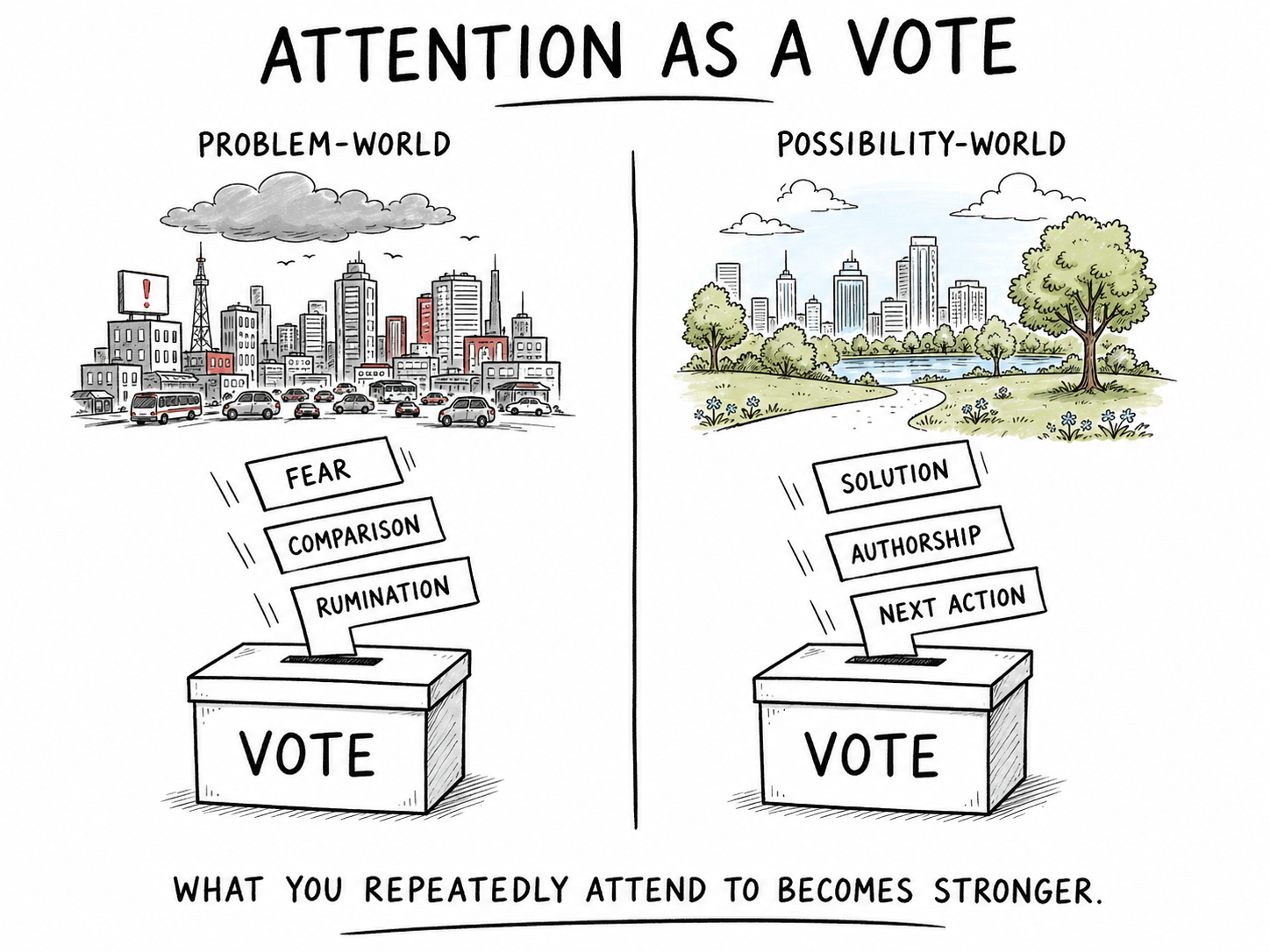
Every moment of attention is a vote for a world.
The vote may be small, but repeated votes become governments.
The vote may look like nothing. The phone is in your hand. The bill is still unpaid. The message still has not been answered. The page is still half-written. One part of you wants to open the feed and borrow someone else’s weather. Another part of you knows the next useful thing is smaller and less dramatic: open the account, write the number, send the direct reply, return to the sentence.
That moment counts.
When you study what is broken without asking what can be built, you vote for problem-world. When you extract information from the problem and turn toward the next useful action, you vote for solution-world.
When you scroll through other people’s lives and use them as evidence of your insufficiency, you vote for comparison-world. When you return to your own work, your own body, your own breath, your own next honest action, you vote for authorship-world.
No single vote decides the whole election. Repeated votes do.
The old model may have years of voting behind it. It may have been elected by repetition long before you knew you had a choice. So do not be discouraged when one good morning does not overthrow an entire regime.
Keep voting.
With attention, language, action, environment, recovery, and the people you allow near your future.
Eventually the inner government changes, and the laws you live by begin to change with it.
Awareness without obsession
Attention training can become another trap if you turn it into surveillance.
I do not want a reader walking around all day interrogating every thought like a police officer with a clipboard. That is not freedom. That is the old model wearing a mindfulness badge.
Train attention with steadiness, not panic. Notice what you are feeding, then redirect without theater. If you discover you have spent the morning in comparison-world, you do not need to punish yourself. Punishment is usually just the old pattern changing uniforms.
You need a stronger vote.
Return to the page. Return to the body. Return to the next honest action. Return to the person in front of you. Return to the skill being built. Return to the world you are trying to strengthen.
Attention is sacred power, but it is also ordinary power. It works through repetition, not drama.
What the spotlight teaches
When you choose an aim, attention receives an assignment.
Some things become tools. Some become obstacles. Most things become irrelevant. Call that orientation, not narrowness.
Much of wisdom is learning what has become irrelevant.
If the dream is too distant, bring the target closer. Place the spotlight on the next visible marker, the next paragraph, the next phone call, the next workout set, the next ten minutes, the next honest action. A distant dream can overwhelm the nervous system. A near target can mobilize it.
Modern life keeps trying to rent your spotlight by the minute. Notifications, headlines, feeds, comments, outrage cycles, comparison loops, AI-generated noise, and productivity tools that create more dashboards than progress. Some of these tools are useful. Many are not neutral. They train the nervous system to treat interruption as normal.
Attention hygiene also means refusing some invitations altogether.
A bad-faith commenter is not always a teacher. Sometimes that person is just a slot machine for your irritation. You pull the handle by replying, and maybe this time you get the little reward: the perfect comeback, the visible dunk, the feeling that the room saw you win. But the machine keeps your attention either way.
Some of us confuse engagement with courage. We think every strange and divisive sentence deserves a full trial, a rebuttal, a closing argument, and a little speech for the invisible jury. It does not. A person can be wrong on the internet without being assigned to you by destiny.
Precision matters. Correction matters. Public lies sometimes need public answers. But attention is finite, and bad-faith rooms are designed to make reasonable people spend unreasonable amounts of life proving they are reasonable.
Before you reply, ask:
“Is this a real conversation, or a performance trap?”
“Will this clarify anything, or only feed the machine?”
“Am I answering because it matters, or because my nervous system wants to win a tiny courtroom?”
Sometimes the strongest vote is silence, the block button, the closed tab, the return to your own work.
So choose the target before the world chooses it for you.
Practice: The Seven-Day Attention Experiment
For seven days, track what your attention is strengthening.
Each evening, write:
- One moment when the old model captured your attention.
- One moment when you redirected attention toward the preferred model.
- One thing you will notice on purpose tomorrow.
Example:
Old capture: I opened the phone to check a message and spent twenty minutes comparing my life to people I do not actually know.
Redirect: I put the phone in the other room, opened the draft, and worked on one paragraph for ten minutes.
Tomorrow’s chosen notice: I will notice the first useful sentence before I notice the feed.
The goal is not to create a perfect week. The goal is to produce an attention receipt. You want evidence of where the mind actually spent itself and what helped you reclaim it.
Practice: The Attention Ledger
For one day, track where your attention goes.
Use three columns:
Attention Given
What did I focus on?
World Strengthened
What world did that focus make more real?
Alternative Vote
What could I attend to instead?
Example:
Attention given: “What if this project fails?”
World strengthened: Failure-world.
Alternative vote: “What is the next controllable action?”
Attention given: “My body is not where I want it to be.”
World strengthened: Shame-world.
Alternative vote: “What action today would respect the body?”
Attention given: “They did not text me back.”
World strengthened: Rejection-world.
Alternative vote: “What else could be true, and what deserves my energy now?”
Do this without self-attack.
You are not judging the mind.
You are learning its voting record.
Vote with the next focus
Attention is more than something you spend. It is something you train. The world you repeatedly notice becomes the world you are most prepared to enter.
Do not demand perfect focus. Cast the next vote. Then cast the next one. A new inner government is not elected by one heroic morning. It is elected by repeated attention, repeated return, and repeated loyalty to the world worth strengthening.