Independent research · Kevin L. Michel
Beyond
Fracture.
Political Stability and Institutional Resilience in Israel through April 2028
A country can keep functioning while its people lose effective protection.
This research examines the distance between institutional survival, the rule of law and the safety people actually experience.
01 / The central distinction
Survival, restraint and protection
can move in different directions.
Israel is likely to retain functioning national institutions through April 2028, according to this assessment. That finding offers limited reassurance about whether legal safeguards work or whether civilians can obtain protection.
Can the state
keep operating?
Institutions need money, staff and authority to carry out core functions.
Look at public payments, government activity, parliamentary processes and courts.
Can the law
constrain power?
A safeguard matters when it changes what powerful officials can do.
Look at binding decisions, compliance, independent review and lawful participation.
Do people
receive protection?
A legal right needs to become usable in daily life.
Look at safe access to homes and services, effective remedies and recurring harm.
A treasury can remain solvent while a court order goes unenforced. A court can issue a ruling while a family remains unable to return home. The report follows the path from a formal decision to implementation and then to the outcome for the person concerned.
Israel, East Jerusalem, the occupied West Bank and Gaza remain distinct analytical settings. Their connections matter, but the report does not pool incidents across them into a new measure of internal Israeli civil war.
Framework and definitions · paper pp. 2–4. This page explains the dated assessment; it is not a continuously updated forecast.
02 / The financial buffer
Resources provide room to act.
They do not settle how power is used.
The September reserve decline does not, by itself, establish investor flight. The Bank of Israel attributed most of the net fall to its revaluation category, which also includes foreign-currency receipts and payments. The 95% figure is not a pure market-price decomposition.
Reserves provide an external financial buffer. They are not a government spending account that can automatically pay for every service or compensation claim.
The July Bank of Israel and IMF forecasts both anticipated growth, at different speeds. Setting annual output in 2025 to 100 makes their implications comparable: the 2027 paths reach 109.72 and 108.05.
These are conditional projections. The Bank’s forecast assumed less intense fighting in Lebanon and no additional fighting with Iran, and still left output below its prewar trend by the end of 2027.
Recovery, at two projected speeds
Annual output, 2025 = 100. July 2026 forecasts; the paths stop at 2027.
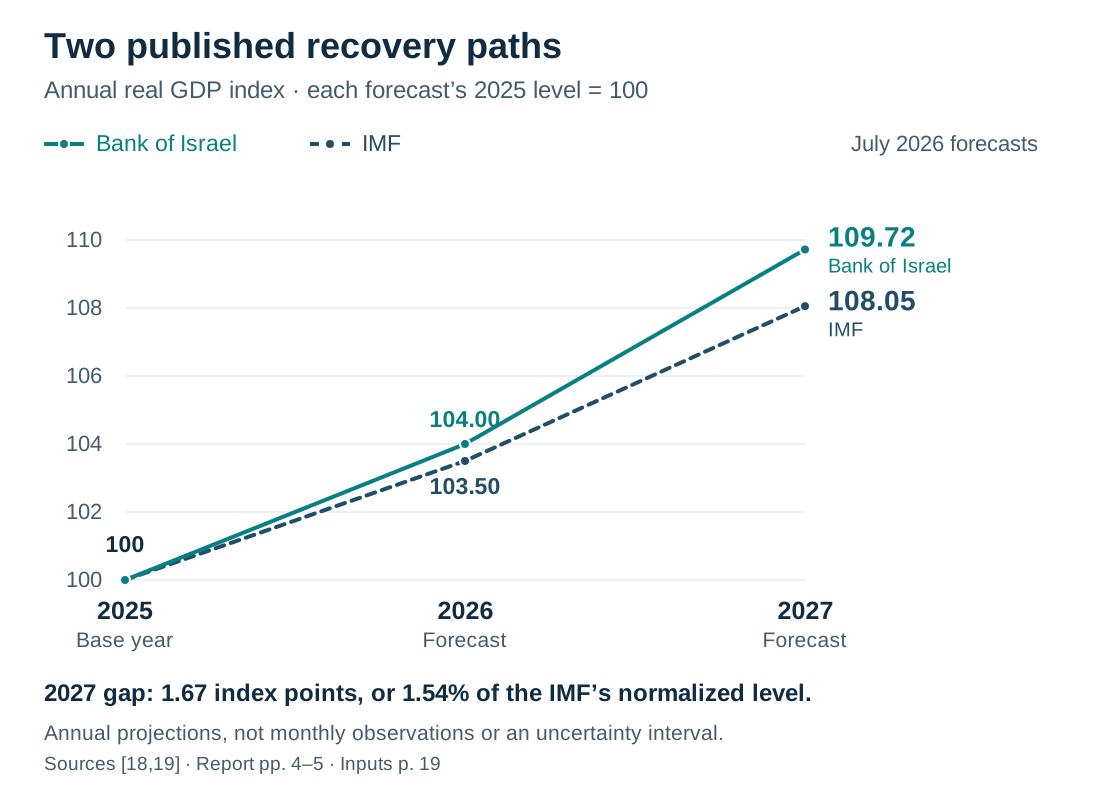
Published growth assumptions: BoI 4.0% and 5.5%; IMF 3.5% and 4.4%. These normalized paths are not observed GDP or a confidence interval. Paper pp. 4–6; Appendix B.
Read the forecast values
| Forecast | 2025 baseline | 2026 | 2027 |
|---|---|---|---|
| Bank of Israel | 100 | 104.00 | 109.72 |
| IMF | 100 | 103.50 | 108.054 |
03 / Participation and confidence
National recovery can hide
unequal burdens.
Reserve participation fell after the initial mobilization period. It did not fall equally across groups.
A smaller absolute gap. A larger relative ratio.
Average-month reserve participation among Jewish men aged 21–44.
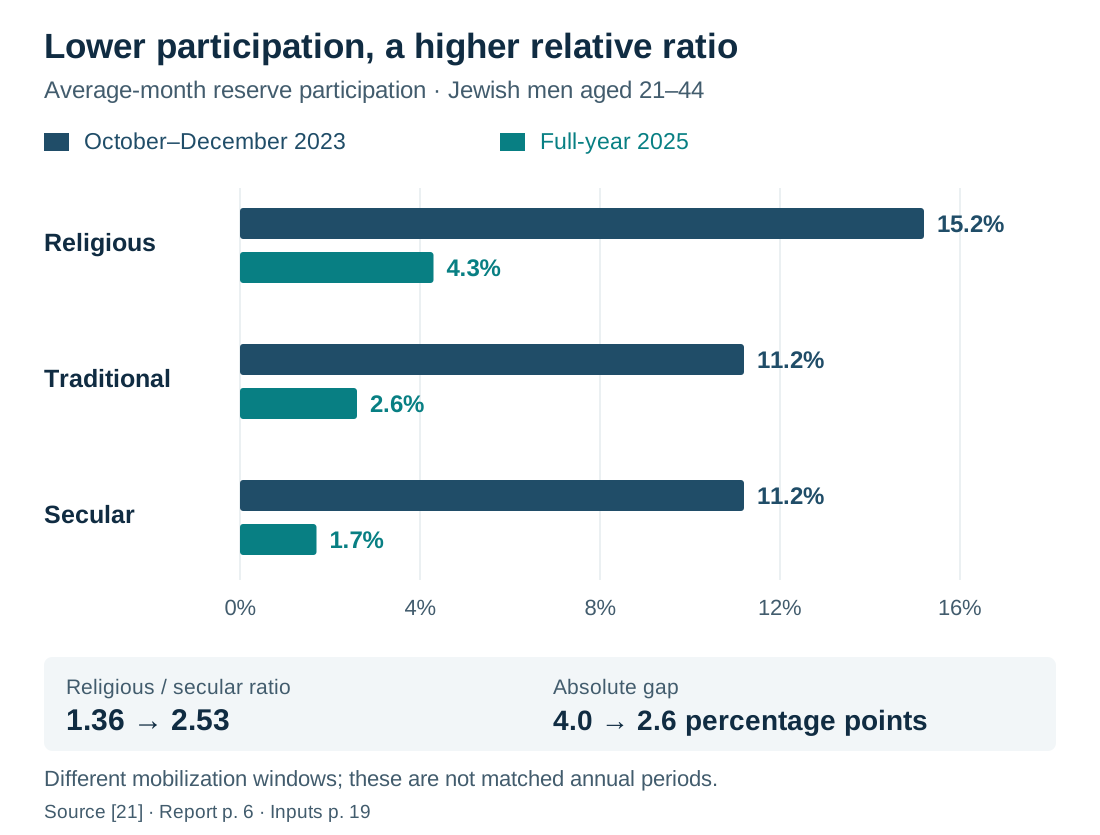
Different observation windows: October–December 2023 and full-year 2025. These rates do not measure total service days or the distribution of all reservists. Source: Israel Democracy Institute, as cited in paper pp. 6–7 and Appendix B.
Both results can be true. Participation fell in both groups, while the secular rate fell by a larger proportion. A ratio describes relative participation; a percentage-point gap describes the absolute difference. Neither establishes individual motives or the full distribution of military service.
Trust did not move in a single direction.
Between the main May 2024 and May 2025 Democracy Index surveys, trust rose for the IDF, Supreme Court and government, while it fell for the police. Government trust remained low. Public confidence and institutional conduct still require separate assessment.
Different institutions, different changes
Published trust percentages in the total adult sample, May 2024 and May 2025.
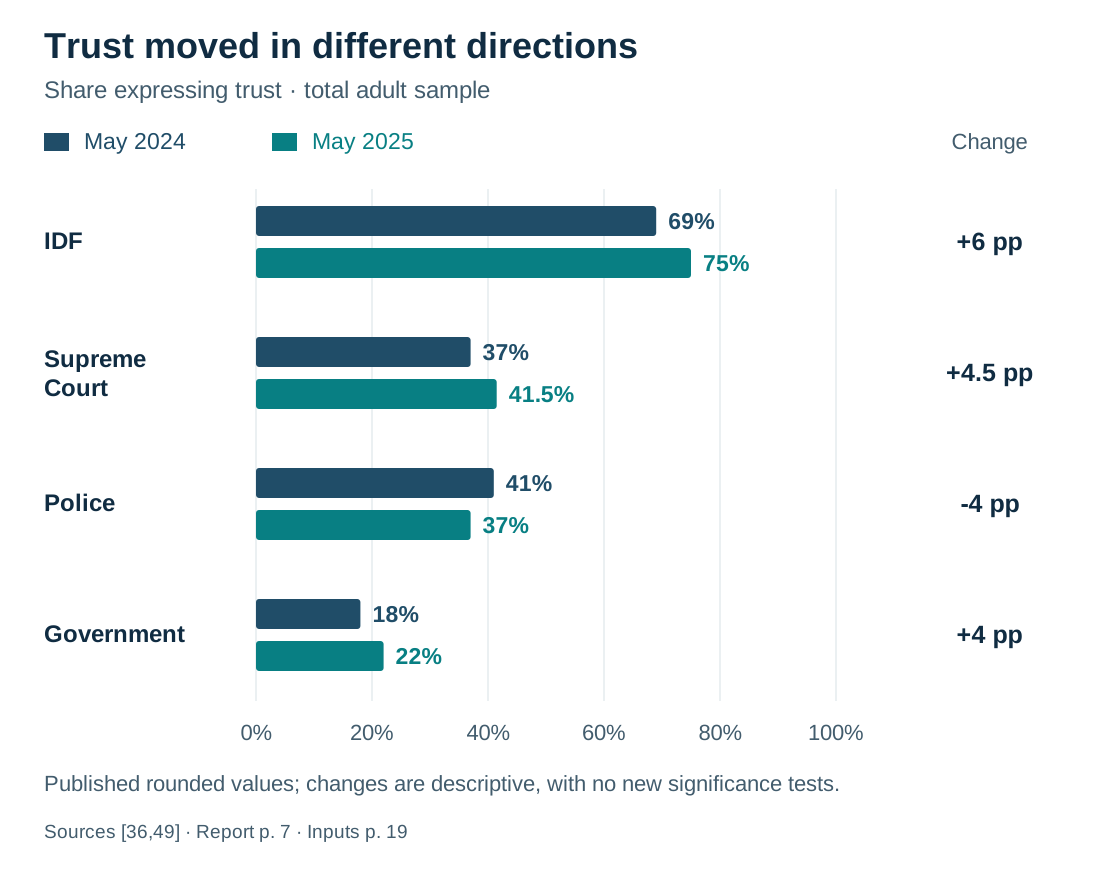
Descriptive comparison of published rounded values. This is not a reading of October 2026 sentiment. Source: Israeli Democracy Index, as cited in paper pp. 7–8 and Appendix B.
04 / Civilian protection
Harm matters even when
national institutions endure.
Recorded West Bank settler attacks rose in January–August 2026. Associated displacement also rose, but its increase was concentrated early in the year.
The comparison period changes the story
Compare the same months in 2025 and 2026.
Recorded settler attacks
+50.8%1,076 in 2025 · 1,623 in 2026
Associated displacement
+115.8%1,212 people in 2025 · 2,616 in 2026
January–August: attacks and associated displacement were higher than in the same months of 2025.
Two measures. Different monthly paths.
Counts of recorded attacks and displaced people are shown separately.
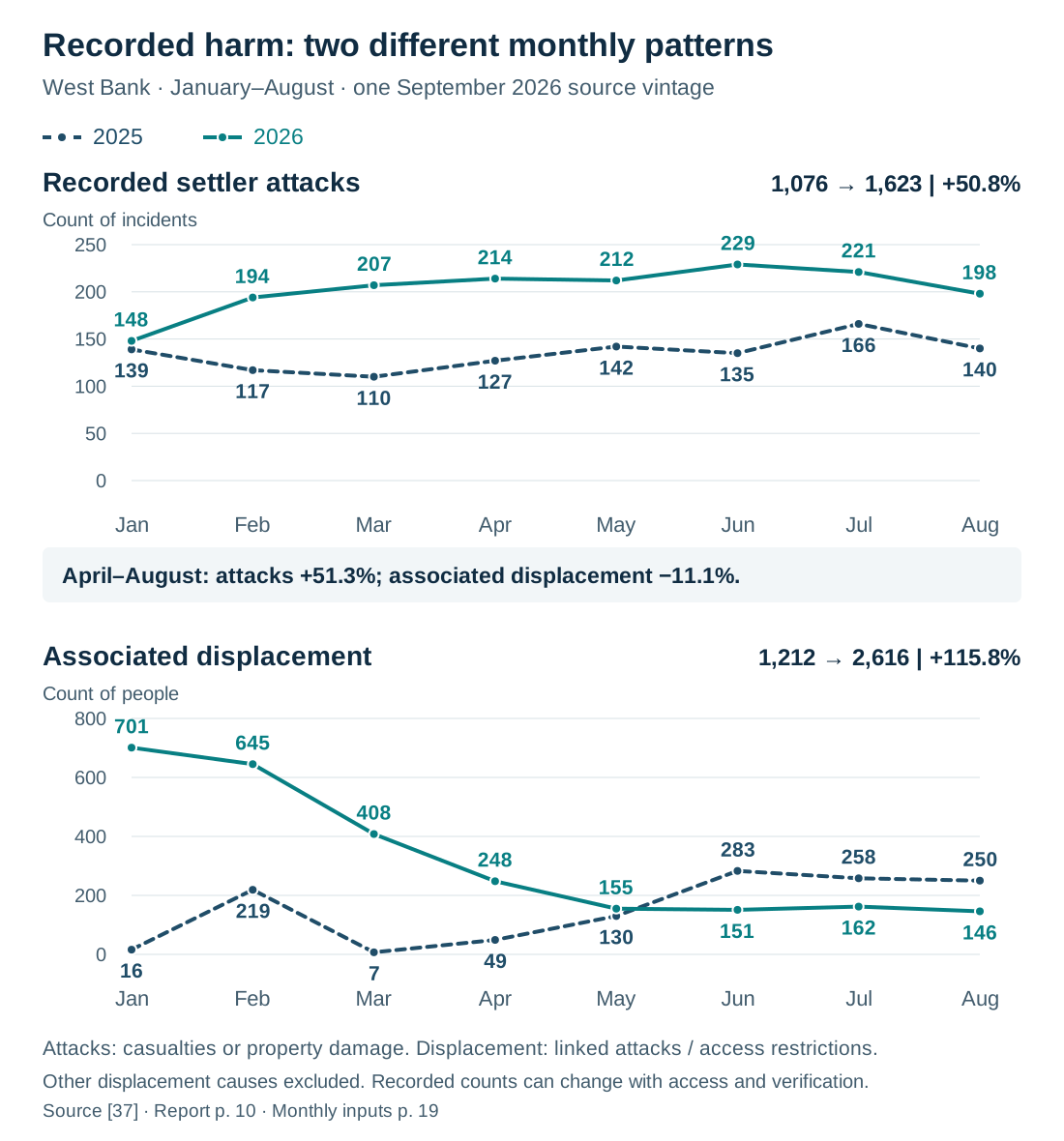
Definitions and coverage: attacks causing Palestinian casualties or property damage; displacement linked to settler attacks and related access restrictions, excluding other causes. Both years use OCHA’s 23 September 2026 source vintage. Access and subsequent verification can affect counts. Paper pp. 10–11; monthly inputs in Appendix B, Table B2.
Read all monthly observations
| Month | Attacks 2025 | Attacks 2026 | Displaced 2025 | Displaced 2026 |
|---|---|---|---|---|
| January | 139 | 148 | 16 | 701 |
| February | 117 | 194 | 219 | 645 |
| March | 110 | 207 | 7 | 408 |
| April | 127 | 214 | 49 | 248 |
| May | 142 | 212 | 130 | 155 |
| June | 135 | 229 | 283 | 151 |
| July | 166 | 221 | 258 | 162 |
| August | 140 | 198 | 250 | 146 |
The protection question is concrete: can people remain in or return to their homes, reach health care and schooling, and obtain an effective response to threats? These outcomes require attention regardless of the state-continuity forecast.
05 / The implementation test
What happens
after the ruling?
The report follows seven institutional episodes. They show correction, unresolved implementation and changes whose practical effects were still prospective at the cutoff.
| Institutional episode | What the record establishes | What remained unresolved |
|---|---|---|
| Judicial appointments | 62 judges and 17 senior registrars took the oath on 15 September. | Remaining vacancies, case processing and independence. |
| Draft-arrest moratorium | The moratorium was annulled on 3 September. Later enforcement accounts differed. | Consistent enforcement and comparable administrative records. |
| Broadcast regulator | Three appointments were annulled; the remaining slate returned for vetting. | A complete record of compliance. |
| Electoral exclusions | Ra’am and Joint List bans were reversed; Cassif remained eligible. | Actual voting, dispute resolution and acceptance of outcomes. |
| Attorney General law | Enacted in July; commencement scheduled for 1 January 2027. | Litigation and practical effects after commencement. |
| Judicial selection | The new arrangement was due with the next Knesset. | Future appointments and the legal challenge. |
| Jalud family | OCHA reported that violence obstructed an attempted court-ordered return. | Safe, effective return and protection. |
External support and pressure also coexist.
Enacted US fiscal-year 2026 appropriations provided at least US$3.3 billion in military-financing grants and US$500 million for cooperative programs. Those figures establish appropriations, not disbursement of every dollar or guaranteed future support.
European individual sanctions and national settlement-product restrictions differ from broader proposals whose enactment the reviewed sources did not establish. Regional escalation could change economic assumptions and household burdens; the report assigns it no automatic effect on domestic cohesion.
External relationships and regional pressures · paper p. 11.
06 / The outlook through April 2028
A judgment should say
what would change it.
Continued national functioning and recurrent civilian harm can occur together. The seven judgments below describe separate outcomes.
Likelihood indicates the direction of judgment. An “unranked possibility” has no reliable directional ranking.
Confidence describes the directness, consistency and completeness of the evidence. These labels are not numerical probability bands.
Continued core national functioning
Public finance and continuing institutional activity support the judgment. A sustained interruption of core functions would change it.
- Assessment
- Likely
- Confidence
- Moderate
Further implemented weakening of legal safeguards
Track rules that enter into force, their implementation, and the ability of independent review to constrain them.
- Assessment
- Unranked possibility
- Confidence
- Low
Prolonged constitutional blockage
Look for an unresolved authority dispute that prevents a necessary national decision. The paper uses a 30-day reporting convention, checked against 14- and 60-day windows; ordinary policy disagreements and lawful appeals do not suffice.
- Assessment
- Unranked possibility
- Confidence
- Low
Recurrent West Bank settler attacks
The report defines recurrence as qualifying attacks in at least two separate months within a six-month review interval.
- Assessment
- Likely
- Confidence
- Moderate
New widespread internal armed contest over Israeli national authority
An organized armed contest is a different outcome from protest, polarization or violence across other settings.
- Assessment
- Unlikely
- Confidence
- Low
Durable fragmentation of Israeli security institutions
Evidence would need to show persistent competing organizational authority, beyond individual dissent or refusals.
- Assessment
- Unlikely
- Confidence
- Low
Generalized Israeli state failure
Broad, sustained impairment of public authority would need to replace the observed evidence of continuing capacity.
- Assessment
- Unlikely
- Confidence
- Low
How would the continuity judgment be reviewed?
A major interruption is defined for this study as at least two core functions broadly unable to operate for 30 consecutive days. This is an author-defined review convention, not a validated collapse threshold. Ordinary caretaker arrangements and normal recesses do not meet it. A later review should check whether 14- or 60-day windows change the classification and record causes separately.
The current assessment does not compile complete time series for every core function. Future reviews need direct records of payments, institutional activity and service access, rather than inference from reserves alone.
Examine election outcomes and legal changes.
Check whether corrections endured and services remained reliable.
Resolve the forecasts, recording earlier interruptions and endpoint conditions.
Proposed review checkpoints, not completed follow-ups. Full definitions, triggers and evidence-to-judgment review · paper pp. 12–14.
07 / From diagnosis to practical action
Make remedies work.
Within 30 days of adoption
Make implementation visible.
The Justice Ministry, court administration and implementing agencies should publish a scoped register of consequential decisions: obligations, deadlines or stays, completed actions and unresolved outcomes.
Evaluate: obligations completed, reasons for delay and duration of unresolved cases.
A 90-day review
Follow remedies through to people.
Responsible protection and enforcement bodies should examine whether court-backed remedies restored sustained access to homes and services, with independent monitoring and safe complaint routes.
Evaluate: access restored, recurring harm and the ability to report failures safely.
Within six months
Clarify obligations and support.
The Knesset and responsible finance, labor and civilian authorities should review service obligations and household disruption, including the timeliness and accessibility of assistance.
Evaluate: payment delays, employment continuity and household disruption.
These are recommendations, not commitments already made or effects already proven. The wider agenda includes confidential mental-health care, reliable essential services and independent journalism that can document whether official actions match promises.
08 / What the evidence can establish
Traceable findings.
Visible limits.
Where the evidence is strongest
Published economic measures, observable institutional events and documented civilian harm. The calculations are reproducible descriptions of published aggregates, with inputs and executed code included in the paper.
Where it remains incomplete
Internal security-institution cohesion, private intentions and the effects of proposed reforms. Some court originals were inaccessible, and the study did not conduct a comprehensive Arabic-language search. It does not estimate a numerical civil-war probability.
The report documents source selection, access limits and research assistance in its appendices. Limits and reproduction materials · paper pp. 16–21.
Read, cite and examine the evidence
Beyond Fracture: Political Stability and Institutional Resilience in Israel through April 2028
Kevin L. Michel · KevinMichel.com · 7 October 2026
The canonical 24-page PDF includes the complete assessment, four original figures, eight tables, 56 references, quantitative inputs and executed reproduction code.
Michel, K. L. (2026). Beyond Fracture: Political Stability and Institutional Resilience in Israel through April 2028. KevinMichel.com. https://doi.org/10.5281/zenodo.23224648