The lower quote arrives at the end of a tiring week. It offers a saving large enough to notice. For a few minutes, this is the whole story: one bill has become smaller.
Then someone asks about the deductible.
It is an annoying question at exactly the wrong moment. The household wanted a piece of good news. It did not want another evening of reading. But the question belongs in the good news, because a saving is more useful when we understand what made it possible.
A policy is a promise with conditions. It describes covered losses, limits, exclusions and the owner’s share. The premium pays for that promise. To compare offers well, we need to imagine the promise being used.
Start with a cause of damage. Then ask how the contract would respond to that cause. The same repair bill can lead to very different payments under different terms. The fact that a house is insured does not mean every way of losing it is insured.
Three prices and four possible years
Consider three invented contracts for the same imagined home. These are teaching examples, not products, quotes or statements about what a lender would accept.
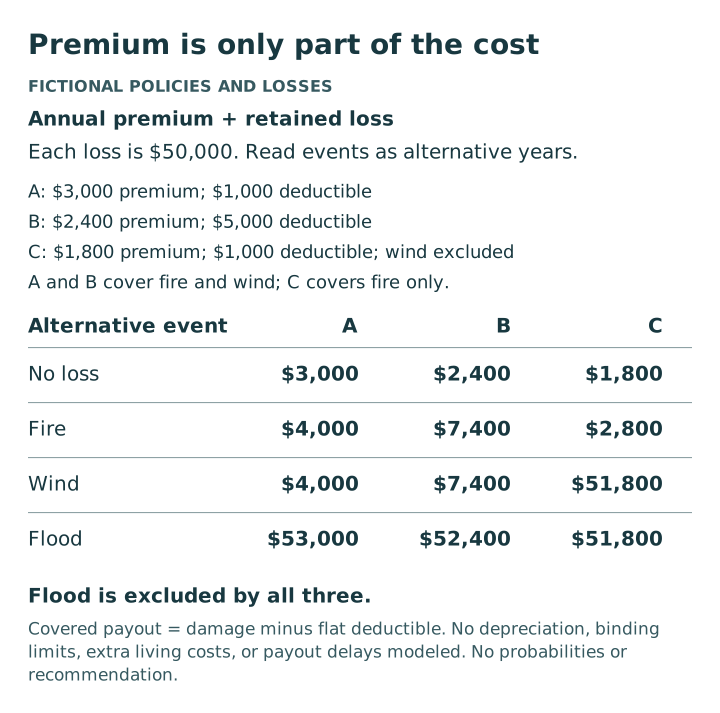
Policy A costs $3,000 a year. It covers the fire and wind losses in our example, with a $1,000 deductible. Policy B covers the same two causes, costs $2,400 a year and has a $5,000 deductible. Policy C costs $1,800 a year, has a $1,000 deductible and covers the example’s fire loss but excludes wind. All three exclude flood.
We will compare four separate possible years: no loss, a $50,000 fire loss, a $50,000 wind loss and a $50,000 flood loss. Each event is a separate alternative year. We do not add all the disasters together.
To make the arithmetic clear, assume that a covered claim is paid at the full stated damage amount less the one flat-dollar deductible. Limits are above $50,000. There is no depreciation, dispute, extra living expense, loan charge or separate policy paying an excluded loss. Actual contracts have more detail, which is why this example can explain a trade-off but cannot choose your insurance.
In the no-loss year, the household pays the premium. A costs $3,000, B costs $2,400 and C costs $1,800. Nothing surprising so far.
In the fire year, A leaves the owner with $1,000 of the damage. Add the $3,000 premium and the year’s premium plus retained loss is $4,000. B leaves $5,000 of damage; with its premium, the total is $7,400. C pays under our stated fire terms, leaving $1,000 of damage; with its premium, the total is $2,800.
The wind year changes C’s position. It excludes that loss, so the owner carries the full $50,000 damage bill. Add the premium and the total becomes $51,800. A and B respond as they did to the fire under this example’s assumptions.
In the flood year, none of these contracts pays. The owner carries $50,000 of damage under every option. The premiums still differ, but none has transferred this particular loss.
Premium is only part of the cost
| Alternative one-year event | Values and meanings |
|---|---|
| No loss |
A: $3,000 premium; $1,000 deductible: $3,000 B: $2,400 premium; $5,000 deductible: $2,400 C: $1,800 premium; $1,000 deductible; wind excluded: $1,800 |
| Fire loss |
A: $3,000 premium; $1,000 deductible: $4,000 B: $2,400 premium; $5,000 deductible: $7,400 C: $1,800 premium; $1,000 deductible; wind excluded: $2,800 |
| Wind loss |
A: $3,000 premium; $1,000 deductible: $4,000 B: $2,400 premium; $5,000 deductible: $7,400 C: $1,800 premium; $1,000 deductible; wind excluded: $51,800 |
| Flood loss |
A: $3,000 premium; $1,000 deductible: $53,000 B: $2,400 premium; $5,000 deductible: $52,400 C: $1,800 premium; $1,000 deductible; wind excluded: $51,800 |
Invented policies on the same property. Each loss is $50,000. Fire is covered by all; wind by A and B only; flood by none. For covered events, payout equals damage less the flat deductible. No depreciation, limits below the loss, percentage deductibles, living expenses, or timing costs. Scenarios are alternatives, not additive. No probabilities or recommendation.
Original illustrative calculations; policies and loss amounts invented
Figure 3. A lower premium can leave more of a covered loss, or an excluded loss, with the household.
We have not assigned probabilities to the four years. Therefore we cannot calculate an expected annual cost or declare one policy the best purchase. A decision would also need real terms, real availability and the household’s ability to meet a loss. The table shows conditional outcomes: if this happens under these rules, this is the arithmetic.
That is already more useful than sorting the three premiums from lowest to highest.
A saving and a bill arrive at different times
Compare A and B more closely. B saves $600 a year in premium and leaves the owner with $4,000 more of a large covered loss. At an unchanged $600 saving each year, it would take six and two-thirds years of savings to equal that one $4,000 difference.
This is an equality between two amounts, not a forecast about when a loss will happen. It assumes the saving is kept, the terms remain unchanged and nothing else uses the money. A storm could arrive in the first year. There could be several covered losses over a longer period. There might be none.
The practical issue is what the household can carry when the event arrives. A family with enough accessible cash may make a different choice from one whose savings are already committed to rent for a parent or a necessary car repair. Both families can understand the arithmetic perfectly.
There is a common temptation to answer this by telling everyone to save the premium difference. That can be a sensible plan when the household has room to do it. It is not a description of what happened simply because the premium is lower. The $600 may be what makes the current year’s essential bills payable.
We should be honest about the choice that remains. Sometimes a person is deciding between a thinner margin after a loss and an unaffordable bill now. That is a real constraint, not a failure to appreciate the importance of insurance. Better consumer information helps identify it. It cannot, on its own, supply the missing income.
This is also why annual totals need a companion question about dates. Even if two options cost the same over a long period, one may demand much more money at once. Money saved next year cannot automatically repair a roof this week.
Four lines worth finding in the contract
The first is the deductible. Is it a dollar amount, a percentage or different amounts for different causes? If it is a percentage, what amount is the percentage applied to? Do not assume a percentage deductible is a percentage of the repair bill. Ask for the dollar calculation for your policy.1
The second is the limit. What is the maximum the relevant part of the contract can pay? A limit for the building is not necessarily a limit for belongings or temporary living expenses. A large number on the first page does not answer every coverage question.
The third is the settlement basis. Replacement-cost coverage and actual-cash-value coverage can produce different payments. The National Association of Insurance Commissioners explains that actual cash value takes age and wear into account, while replacement cost concerns repair or replacement with like materials. Neither term means the property’s sale price, which also reflects land and the market.2
The fourth is the exclusion. Which causes or kinds of damage are outside the promise? An exclusion does not become less important because the document places it far from the price.
These lines interact. A covered event may still leave a deductible and amounts above a limit. A replacement-cost promise may carry conditions you need to meet. An excluded event may never reach the deductible calculation at all. Ask the agent or insurer to explain the whole path from the described damage to the payment, and keep the written answer with the documents.
That last step is worth the few extra minutes. Memory is a poor place to store a qualification that could later matter a great deal. A clear reply can also reveal whether two people are using the same word differently.
Water needs a more precise question
Water inside a house is an experience. Insurance distinguishes causes.
The fact that the room is wet does not tell us which part of a policy applies. The useful question is how the water arrived and what the contract says about that cause. Asking whether a policy covers water is often too broad to produce a reliable answer.
Most homeowners and renters policies do not cover flood damage. The National Flood Insurance Program offers separate building and contents protection, and those coverages can have separate deductibles. Its coverage also has limits and exclusions; for example, NFIP policies do not pay temporary housing or additional living expenses during repairs. A policy can be valuable without covering the whole cost of displacement.3
Private flood policies can have different terms. Do not carry a statement about NFIP into every product sold under the word flood. Identify the actual policy and ask which costs it pays, which limits apply and when coverage begins.
The wider habit matters beyond water. Ordinary language gathers things together: storm damage, a damaged roof, a home we cannot live in. Contracts divide them into causes, sections, dates and conditions. The reader does not have to admire that complexity. The reader does have to know where it can change the outcome.
I would like that work to be easier. A household comparing protection should be able to see the main uncovered losses and possible out-of-pocket costs without hunting through a maze of labels. Clear summaries help, provided they remain connected to the actual terms rather than replacing them with reassuring language.
What remains yours
There are losses that no payment fully repairs. A child’s drawing. A table made by someone who is gone. The sense of knowing where everything is in the dark.
We do not need to put a dollar figure on these things to take them seriously. In fact, insisting on a price can make the account less accurate. Insurance is a financial arrangement. A home is also a place where a life has gathered.
That is one reason prevention deserves more attention than it gets in a shopping comparison. If damage is avoided, some losses never need to be translated into a claim. If it cannot be avoided, preparation can still help preserve what is hard to replace. The right steps depend on the danger and the person, and safety comes before possessions.
The chair keeps the shape of an evening.
The drawer holds a letter folded twice.
A cup waits beside the sink.
We learn the price of the timber.
We list the glass and the hinges.
The letter has no useful column.
Before the rain, someone lifts the box.
Someone writes down where it has gone.
Someone leaves with time to spare.
Later, there will be forms to finish.
For now, the door closes behind them.
They take each other along.
Keep the uncovered part visible
A good comparison does not end with a frightening list of everything that could go wrong. It ends with a clearer allocation of responsibility.
Here is what the insurer promises. Here is what another policy might cover. Here is what the household would carry. Here is what remains uncertain. Those statements give the household something to work with.
Some gaps may be affordable. Some may be reduced by changing coverage or reducing the chance of damage. Some may be too large for the household to carry and require a different housing decision or help beyond the household. A serious discussion allows all of these answers.
It also allows a person to ask for time. A quote that is cheaper this afternoon may still deserve a careful comparison tomorrow. The point is not to make ordinary people timid. It is to help them make commitments with their eyes open.
The lower premium can still be good news. It becomes better news when the household knows what remains its own.
Footnotes
-
NAIC, tips for comparing homeowners insurance, especially percentage deductibles. Check the basis and triggers in the actual contract. ↩
-
NAIC, actual cash value and replacement cost, January 2, 2025. The three-policy comparison is independently invented arithmetic, not a reproduction of its example. ↩
-
National Flood Insurance Program, buying flood insurance, coverage and exclusions, checked October 2026. Private policies require their own review. ↩