The notice is on the kitchen table, under a set of keys. Nothing about the house looks different. The porch still needs paint. The same narrow patch of morning sun reaches the floor. The family has lived here long enough to know which cupboard door will not stay shut.
The payment has gone up.
At first this seems like a mistake. They chose a fixed-rate mortgage. That was the point of all the forms, the rate comparison, the careful question before signing. They wanted one important part of life to stop moving.
The letter does not say the interest rate has changed. It says the amount collected for insurance has changed. It also mentions an escrow shortage. There is a table with several columns. A person can read every word in such a table and still need to ask what happened.
A fixed loan payment does not fix every cost of keeping a home.
A fixed rate can hold the principal-and-interest payment steady while other housing costs move. An escrow account collects money for expenses such as insurance and property taxes, which the mortgage servicer pays on the owner’s behalf. When those bills change, the amount collected can change too. Without escrow, the owner must arrange to pay the bills directly. Either way, the expense still belongs in the budget.1
So the family’s first useful question is quite specific. Which part changed?
It is a better starting point than wondering whether they have somehow failed at homeownership. They need the old premium, the new premium and the escrow statement. They need to see which amounts pay for the coming period and which settle something left over from an earlier one. Before they decide what to cut, they need a clear account of what they are being asked to pay.
A house has more than one clock
The mortgage may last for decades. Insurance is renewed on a much shorter cycle. A roof has its own life, as does a water heater. The town decides when to repair a drain. A household’s pay can change next month. A storm does not wait for any of these schedules to agree.
We usually put these things into one word, affordability, as if it were a single number decided when a lender approves a loan. But a home must remain affordable through time. The household has to make each payment when it falls due, carry the costs its insurance leaves behind and keep enough room for the rest of life.
That sounds obvious until we watch how homes are compared. A buyer checks the sale price. The lender supplies a monthly estimate. Friends discuss the interest rate. The insurance quote sometimes arrives late, when the buyer is already picturing the furniture in the rooms.
The order matters. A cost discovered after an emotional decision has a different effect from a cost included before it. It becomes an obstacle to the desired house rather than part of the decision about whether this is the right house.
I think we should bring more of those later costs into the first conversation. We should also stop expecting a household to predict them perfectly. No buyer can know every future premium, repair bill or public decision. The goal is to understand which costs can move, how far the budget could bend and which unanswered questions deserve attention before a commitment.
There is dignity in this kind of preparation. It lets a person say, I understand the offer, and I know what I still need to find out. It also lets a person say, This works only if nothing becomes more expensive, which is a very different conclusion from This works.
The extra hundred dollars
Let us work through a deliberately simple example. These amounts are invented to show timing, not to represent a typical household or a quote available in the market.
Suppose an annual insurance premium rises from $2,400 to $3,600. The increase is $1,200 a year, or $100 a month if it is spread evenly across twelve months. Hold the loan payment, property tax and every other cost still for a moment. The continuing extra expense is $100 a month.
Now suppose the escrow account also has a separate $1,200 shortage from an earlier period. This is an existing amount owed. It is not the new premium increase counted a second time.
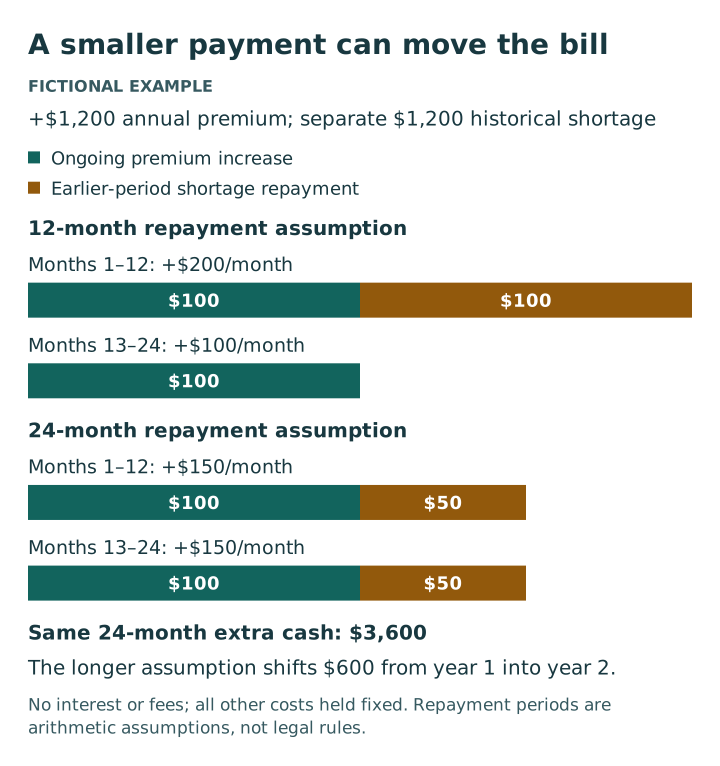
If that old shortage were repaid in twelve equal monthly amounts, it would add another $100 a month for the first year. During that year, the extra cash leaving the household would be $200 a month: $100 for the higher ongoing premium and $100 to settle the earlier shortage. In the second year, after the shortage is cleared, the extra amount would fall to $100 a month, assuming the premium remains unchanged.
We can compare a second arithmetic schedule in which the same old shortage is spread over twenty-four months. That would add $50 a month to the $100 continuing increase. The extra payment would be $150 each month for two years.
These repayment schedules are assumptions in the example. They do not state what a servicer must offer or what a particular borrower may choose. Actual statements, contracts and applicable rules need their own check. We have also left out interest, fees, changes to an escrow cushion and any later shortage.
A smaller payment can move the bill
| Assumed repayment | Values and meanings |
|---|---|
| 12 months |
Extra monthly, months 1–12: $200 Extra monthly, months 13–24: $100 Year 1 extra cash: $2,400 Year 2 extra cash: $1,200 24-month extra cash: $3,600 |
| 24 months |
Extra monthly, months 1–12: $150 Extra monthly, months 13–24: $150 Year 1 extra cash: $1,800 Year 2 extra cash: $1,800 24-month extra cash: $3,600 |
Fictional arithmetic only: annual premium rises from $2,400 to $3,600 and stays there; a separate earlier-period $1,200 shortage is repaid without interest or fees. Equal installments, no escrow-cushion adjustment, and all other expenses held fixed. The repayment periods are not legal rules or promised servicer options.
Original illustrative calculations; all dollar inputs invented
Figure 1. Repayment timing changes the first year’s strain, while the two-year total stays the same.
Under the twelve-month schedule, the extra outflow is $2,400 in year one and $1,200 in year two. Under the twenty-four-month schedule, it is $1,800 in each year. Both add up to $3,600 over two years. Of that amount, $2,400 covers two years of higher premiums and $1,200 pays the old shortage.
The second schedule moves $600 of cash outflow from the first year to the second. It does not make the old shortage disappear or return the premium to its old level.
This is a small calculation with a large practical use. It separates two problems that can otherwise look like one. A household may need help with a temporary squeeze, a permanently higher expense, or both. Spreading an old balance can ease timing. It cannot by itself make the continuing cost fit the household’s income.
Imagine that there is $170 of room in the monthly budget. The $200 increase does not fit. The $150 increase does, with little left over. That is an important difference this month. Yet it tells us nothing about a car repair, a lost shift or another increase next year. The calendar has improved; the margin is still thin.
I would rather see that thin margin plainly than cover it with a confident label. A payment can be manageable and leave a household exposed. A temporary arrangement can be valuable and still need a longer plan.
Weather travels through decisions
Wind, water, fire and heat can damage homes. The money consequences depend on more than the force of the event. They also depend on where people have built, how the building holds up, what repairs cost, what a policy covers and who has agreed to pay.
Think of two similar storms passing through two different neighborhoods. One has drains that are maintained and homes whose vulnerable equipment is raised. The other has blocked drainage and equipment near the floor. Then imagine the same damage in two homes with different contracts. One owner has coverage for that cause of loss; the other does not. Now give them different savings and different jobs.
The physical event is only the beginning of the comparison. Their bills and their ability to recover can diverge at every step.
This book follows those steps. It asks how a hazard becomes a loss, how some of that loss enters an insurance price, and how that price reaches the budget. It asks what happens to a home’s value, what lenders need, and what towns inherit when a problem reaches beyond one property line.
It will not treat every increase in insurance as a measurement of climate change. A premium is the price of a particular contract in a particular market. Building costs, coverage choices and insurance-market conditions can change that price too. Nor will it turn uncertainty about one bill into an excuse to ignore physical risk. Those are different questions, and we can take both seriously.
The most useful habit is to keep asking what the number describes. Is it the chance of damage? The estimated amount of damage? What an insurer expects to pay? What the insurer charges? What the homeowner must still pay? Each answer points to a different decision.
A higher deductible, for example, can move part of the bill from the premium to the owner after a loss. The smaller annual invoice may be welcome. But the transfer is not complete until we ask whether the owner could meet that later bill.
The renter is in this story too
The title mentions a mortgage because a mortgage statement makes the connection visible. It does not mean that only borrowers bear housing risk.
A renter may face damaged belongings, time away from home, a difficult search for another place or changes in the landlord’s costs. Which expenses reach the rent, and when, depends on the lease, local rules and the housing market. We cannot assume an owner’s higher bill is passed through immediately or in full. We can say that renters need their own questions about protection and displacement.
An owner who has paid off the mortgage still has a building to maintain and possible losses to meet. The absence of a lender can remove one set of requirements; it does not remove the storm, the fire or the cost of repairs.
And a neighbor whose home stays dry may still need the flooded road to reach work. A place is supported by systems no one household can purchase alone. Keeping an individual home in good shape matters. So does what happens to the road, power supply and public services around it.
This is why I resist the idea that the whole answer is to become a better shopper. Comparison is worth doing. A clearer policy can prevent an expensive misunderstanding. But a household cannot shop its way into a repaired public drain, a stronger local tax base or a well-run recovery program. Those require decisions made together.
Start with the bill you have
Return to the kitchen table. The family does not have to solve the country’s insurance problems this morning. It needs a manageable first task.
Put the old and new documents side by side. Identify the premium period. Mark the ongoing change separately from any amount owed for the past. Check whether coverage, limits or deductibles changed as well as price. If the statement is unclear, ask for the calculation rather than guessing at the total.
Then bring the dates into the household budget. When does each amount start? When does a temporary amount end? What happens if income falls for a month? What expense would have to be postponed, and would postponing it create another risk?
Some answers may be uncomfortable. There may be no easy saving to find. A book should not pretend every family has a forgotten luxury waiting to be cut. Sometimes the problem is that essential costs exceed what the household can reliably pay. Naming that problem accurately makes it easier to seek the right kind of help, and harder to mistake it for poor discipline.
There is also room for relief. A confusing increase may contain a temporary part. A coverage question may have a clear answer. A renewal may leave enough time to compare real alternatives. Clarity does not promise a cheaper outcome, but it can stop several different worries from becoming one shapeless fear.
The keys are still on the table. The house is still a home. What has changed is the account of what it takes to keep it.
That account is where we begin.
Footnotes
-
Consumer Financial Protection Bureau, escrow accounts, reviewed September 2024. The example and repayment comparisons are original hypothetical arithmetic. ↩