The event begins at nine on Saturday morning. You want to arrive rested, stay close enough to walk there, and avoid spending more than $350 on two nights of lodging and local transport.
That is a different request from “Find a hotel under $175 a night.” The second version looks precise. It supplies a price and a unit. It also leaves out transport, required charges, location and the reason a quiet night matters. An assistant could obey it exactly while producing a trip you would never have chosen if all the consequences had been visible together.
We will follow the fuller request. The numbers are constructed, all in U.S. dollars. They are deliberately simple enough to inspect.
Hotel A costs $260 for two nights, including mandatory lodging charges. Reaching the event and making the other necessary local journeys would cost $80. Hotel B costs $310 for the same stay, with $10 in local transport. For this example, those amounts cover the same required journeys; meals and travel to the city are outside the comparison.
The cheaper room produces the dearer stay. Hotel A totals $340. Hotel B totals $320.
Constructed example · US dollars for two nights
| Hotel | Lodging | Transport | Total |
|---|---|---|---|
| A | $260 | $80 | $340 |
| B | $310 | $10 | $320 |
All mandatory lodging charges are included. Meals and travel to the city are outside this comparison. These are invented costs, not real hotel quotes.
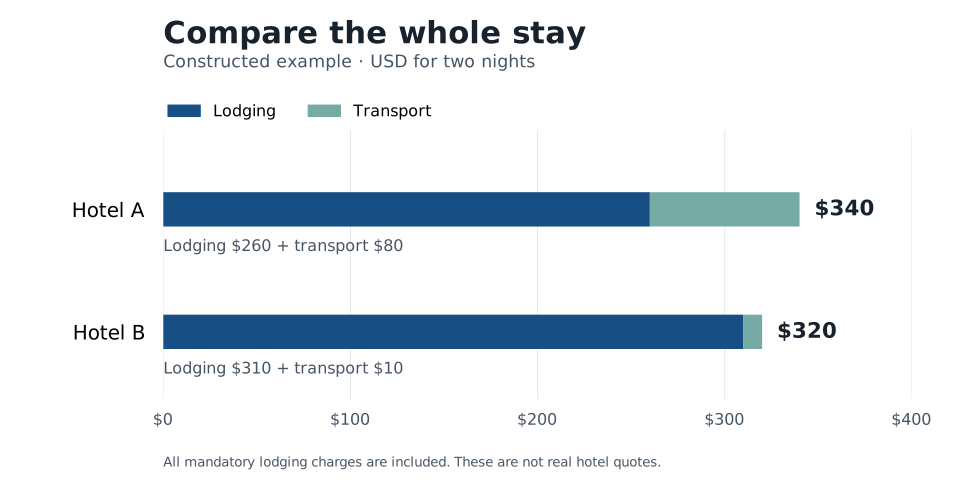
Figure 1. Invented costs for the example, including all mandatory lodging charges. The comparison shows lodging and required local transport, not every cost of the trip.
The arithmetic takes a moment. Defining what belongs in the arithmetic takes judgment.
Begin with the whole task
A competent assistant should compare the costs that the request actually covers. This sounds obvious until we see how easily a task is divided across tools. One tool finds a room. Another estimates transport. A third handles payment. Each can produce a correct answer to its own narrow question while the combined plan exceeds the person’s budget. The user should not have to hold the whole plan together after asking the assistant to do so.
The budget belongs to the trip as defined, not independently to every component. If there is $350 for lodging and local transport, permission to spend up to $350 on the room would use the same money twice when another service later arranges the journeys. A useful assistant should preserve the shared limit as the work moves between steps.
There is another boundary to preserve: the required result. In our example, Hotel B has the lower combined cost and allows the walk to the event. But that does not establish every part of its suitability. We still need to know whether the room is available for the right nights, whether late arrival is allowed, and whether the information about location applies to the actual property rather than another branch with a similar name.
An inexpensive mistake remains a mistake. The FTC’s online-shopping guidance recommends checking total cost, exact product details, seller terms and records. Although written for ordinary online shopping, its practical discipline is useful here too.[1] The assistant should reduce the work of making those checks, while making any important gap visible before the commitment.
A comparison can also be wrong because its units differ. One listing may show a nightly rate and another a total. A price may apply to one guest while the request concerns two. A room category may change between search and checkout. The assistant should carry the same dates, occupancy and requirements through the whole task, rather than compare attractive numbers that refer to different things. For a person doing the work manually, these details are tedious. For a service promising to do the work, they are part of the job.
Notice how little this has to do with dazzling conversation. The assistant needs to maintain a few facts consistently while moving through changing pages. It should know which amount is a quote, which is an estimate and which has been accepted. If it cannot verify a material cost, it needs to tell the person what remains uncertain.
It can still be helpful. An estimate with an honest range may be more useful than refusing to proceed until every variable is fixed. But a range must leave room in the budget for the result that may actually occur. Spending the entire allowance on a plan that assumes the lowest possible transport cost shifts the uncertainty onto the user. A sensible recommendation could therefore say that Hotel B currently leaves $30 of room within the $350 limit. It should not silently treat the remaining $30 as a reason to add something.
A budget is a ceiling, not a target the assistant is obliged to hit.
The facts a bar cannot hold
The chart has settled one question: in the figures given, Hotel B costs $20 less for the same two-night lodging-and-transport bundle. It has not priced your sleep. Nor should it.
You might be willing to pay more to avoid a long journey after the event. You might prefer a familiar hotel. You might know that an early start leaves you exhausted. These considerations matter, but assigning them a dollar value without asking would make the calculation appear more objective than it is.
The assistant can make the tradeoff visible in ordinary terms. Hotel A costs this much, requires this journey, and has these limits. Hotel B costs that much and changes the morning in these ways. The person can then decide how much the difference matters to them.
For this trip, being able to walk to the event was part of the request. The assistant should not quietly discard it in pursuit of a lower room price. If it finds no suitable option within the budget, that is a real conflict to bring back. The user may raise the limit, accept a longer journey or change the trip. None of those choices should be smuggled into the plan as if it had already been made.
This is one of the most valuable things an assistant can do: identify a conflict early enough for the person to resolve it cheaply. A hotel may be affordable before transport and unsuitable after it. A room may be available but inaccessible to someone who cannot manage the stairs. A cheap arrival time may require missing the first session. The result needs to be judged against the person’s purpose, including requirements that are easy to lose when the task is broken into small steps.
There is no virtue in presenting ten options that all violate the same important condition. That creates the appearance of choice while leaving the problem untouched.
A good assistant may return with fewer options and a more useful explanation. It may also say that the stated combination is not available. That answer can be disappointing and still save the person from a worse disappointment later.
The price of changing your mind
Now the trip becomes uncertain.
You expect to attend, but there is a chance you will have to cancel. Hotel B’s $310 lodging rate is nonrefundable in our example. A flexible rate for the same room costs $350 and returns the full lodging payment if you cancel before the stated deadline. The $10 transport expense occurs only if you take the trip and is the same under both rates.
The flexible choice would cost $360 if you travel. It exceeds the original trip budget by $10. That is a point at which the assistant must come back to you. The extra cost may be sensible. It remains extra cost, attached to a different commitment. A service should not convert “this may be worth it” into permission to exceed the limit.
We can inspect the financial tradeoff without pretending to know whether the trip will be canceled. Under these assumptions, the nonrefundable lodging costs $310 whether you attend or cancel. The flexible lodging costs $350 if you attend and nothing if you cancel in time. Ignore other differences for the moment.
If there were a ten percent chance of canceling within the allowed window, the flexible lodging would have an expected cost of $315: ninety percent of $350. At twenty percent, its expected cost would be $280. The break-even chance is about 11.4 percent, found by dividing the $40 premium by the $350 that would be refunded. The identical transport costs do not change which rate is cheaper in this comparison.
This is a calculation under chosen conditions, not a prediction about you. It assumes timely cancellation, a full lodging refund and no other rate differences. A partial refund, an earlier deadline or a fee would change the result.
Even with a reliable probability, expected cost would not answer the whole question. It is an average across possible outcomes. You will experience one outcome. If you travel, the flexible room costs more. If you cancel in time, it protects money you would otherwise lose.
A person with little room for a loss may value that protection more than someone with a large cushion. Another person may be almost certain of attending and prefer to retain the $40. Someone else may value the freedom to decide later, even when the cheapest average outcome points the other way.
The assistant can clarify the arithmetic. It cannot infer the correct attitude to uncertainty merely from the fact that it can multiply.
This is where the phrase “optimize the trip” can become misleading. An optimization needs a goal. Minimize the expected cost? Limit the worst plausible loss? Stay under the amount available today? Preserve the option to cancel? These aims can lead to different choices.
A helpful assistant should recognize when the calculation has reached a value judgment. It can explain the consequences of each choice and ask a focused question. It should not bury the question beneath a confident declaration that one rate is mathematically best.
For our traveler, the $350 ceiling may be firm because that is the money available. In that case, the flexible option is unaffordable despite its potential value. The assistant should continue searching or present the tradeoff honestly. It should not shame the person for declining protection they cannot pay for.
What exactly is being approved?
Suppose you choose the $310 room at Hotel B. You accept the nonrefundable condition and keep the total lodging-and-transport plan at $320.
The approval should correspond to that choice.
A useful review includes the property and room, dates, number of guests, total lodging charge, payment terms and the cancellation condition. It should also make clear which parts of the plan are being booked now. Approving the room does not necessarily authorize a transport booking, an insurance product or a subscription offered during checkout. The details should be presented before the act becomes difficult to reverse. If the room type changes or the price rises, the approval may no longer cover the proposed transaction. The assistant needs to recognize a material change rather than rely on an earlier yes to a different offer.
This is especially important when a broad goal is carried through several services. The user may approve a trip budget without authorizing every possible use of it. They may permit a hotel payment but decline a deposit for an activity. They may want an itinerary without asking the assistant to invite anyone.
A well-designed process keeps the authority tied to the actual action.
Too much detail can obscure the decision. The user does not need every page the assistant visited repeated in the approval request. They need the facts that define the commitment, plus any unresolved issue that could reasonably change their answer. There should be no prize for turning a review into a document so exhausting that the person stops reviewing it.
After approval, the task still has a distance to travel. The booking request has to reach the seller and be accepted. Payment may need to be authorized or collected. A confirmation should identify the reservation. If the assistant encounters a timeout, it should establish whether the booking went through before attempting it again.
An uncertain response is not the same thing as a failed transaction. Treating it as one can produce a second booking while the first is already valid. The useful next step is to check the record through an appropriate route, rather than solve uncertainty by pressing the button twice.
The person who asked for help should receive a result they can use: the confirmed booking, its key terms and the practical details needed on arrival. A cheerful message saying “All sorted” is a poor substitute for a reservation that can actually be found.
The journey after checkout
A trip can change after a booking is confirmed.
The event moves. A train is canceled. You decide to arrive later. If the assistant has been asked to monitor these developments, it needs to know which changes matter and what it may do about them. Detecting a problem is one task. Committing to a replacement is another.
The original budget should remain in view. Suppose a delay makes Hotel B difficult to reach. The assistant finds an alternative that would avoid the problem but would create another charge while the first room remains nonrefundable. The relevant cost is no longer simply the price of the new room. It includes the money already committed and any recovery actually available. That is the sort of moment in which an assistant could be highly valuable. It can gather the options quickly, establish what has changed and explain the consequence of each route. It can save the person from making a rushed decision with half the costs missing.
It can also create trouble by trying too hard to deliver a finished result. Rebooking may feel like progress. If the authority to rebook is absent, the action has outrun the help. The same distinction appears in a much smaller task: canceling a subscription.
A user asks the assistant to stop a recurring charge. The assistant sends a cancellation request. Has the task been completed? That depends on the service’s actual process. A request may need confirmation. There may be a remaining paid period, stored material the user wants to retain, or a different consequence of closing the account.
The assistant should establish what changed, when it takes effect and what evidence supports that conclusion. It should not replace one recurring cost with another paid service unless the user has authorized the new commitment.
These are ordinary administrative details. They are also where the promise of personal assistance either holds or fails. The user wanted the unresolved matter out of their life. The assistant must be careful about declaring success while the matter remains open somewhere else.
What the saved time is for
There is a temptation to measure assistance by how much activity it produces. In the trip we have followed, much of the valuable work is restraint. The assistant keeps the budget attached to the whole plan. It does not add a purchase simply because there is money left. It brings back a conflict instead of deciding that the user’s requirement was inconvenient. It checks an uncertain transaction before trying again.
These acts may leave fewer visible signs than a long itinerary or a stack of confirmations. They can matter more. The point of the trip is to arrive ready for the event. A good plan gives you a workable morning. The receipt may show a room and a price; your life contains the walk, the sleep and the attention you can bring to the day.
Money can sometimes be returned. A missed morning cannot be delivered next week.
This is why the person must remain present in the definition of success even when absent from the work. Their purpose should survive the passage through search, comparison, approval and booking. If it does, delegation can give them something more valuable than a list of completed steps: a stretch of time that is genuinely free to use.
At Hotel B, the room has been confirmed. The dates are right. The total fits the limit you chose. You know the cancellation condition and have the record if something goes wrong.
On Saturday, you close the door behind you and walk to the event.
The assistant has done enough.
Sources and calculation note
[1] Federal Trade Commission, “Online Shopping,” May 2023, accessed September 30, 2026. Used for the general practice of checking total costs, seller and refund terms, and retaining records. The trip is a constructed illustration, not a statement of a particular hotel contract or a universal legal right.
The hotel figures and cancellation calculations are original illustrations. Hotel A: $260 + $80 = $340. Hotel B: $310 + $10 = $320. With nonrefundable lodging at $310 and fully refundable lodging at $350, valid cancellation probability p gives expected flexible lodging cost $350 × (1 − p). Break-even is p = 40/350, approximately 11.4%. Both rates have identical $10 transport only when traveling. No additional taxes, fees, insurance, replacement costs or partial-refund conditions are included.