Did you already add the salt?
The spoon is on the counter. The container is open. Someone asked a question while you were measuring, and now you cannot remember whether you added it or only meant to add it. The difference is small in language and large in dinner.
You have not forgotten how to cook. You have lost your place.
This happens with invoices, instructions, forms, and conversations. A person can know the job very well while being uncertain about which part has just been done. More expertise does not always answer a question about the last ten seconds. The action was familiar enough to perform, but its completion has become hard to recover.
One response is to begin again. Another is to guess. A third is to find a trace in the world: a checked box, a moved object, a line already entered. The interruption has created work that was not on the original list. Before you can proceed, you have to discover where you are.
The length of the interruption does not tell us the length of that discovery.
A place can be lost in a moment
Erik Altmann, J. Gregory Trafton, and David Hambrick tested brief interruptions during a laboratory task with a sequence of steps. Interruptions averaging 2.8 seconds doubled errors in following the sequence; those averaging 4.4 seconds tripled them. Other kinds of errors did not show the same effect.[1]
The finding concerns that task and those comparisons. It does not mean every short message doubles your chance of making every kind of mistake. Its force lies in the distinction: an interruption can damage the thread of a sequence without destroying the ability to perform its individual steps.
This gives us a better question than whether someone is generally good at concentrating. What must be kept in mind for the next step to be correct?
Suppose you are assembling a small cabinet. The parts look similar. The drawing marks a hole on one side, and you have finally worked out which way the panel belongs. Then you leave to answer the door. When you return, the panel is still there, but your understanding of its orientation may no longer feel secure. You inspect the drawing again. A friend watching might think you are being slow. Part of the time is being spent paying again for a conclusion you had already reached.
Now suppose you had placed the panel in its final position before leaving. The world would hold some of the answer for you. The next step would be easier to recognize. You have not increased the strength of your mind. You have reduced what the mind must reconstruct.
There is a general lesson here for the design of work. A task should, where possible, leave evidence of its own state. Which item is complete? Which version is current? What remains uncertain? A clear record is not an admission that people are foolish. It is a way of making a real process survivable when life enters it.
The same principle helps a conversation. If two people pause a difficult discussion, a sentence about where they have arrived can prevent them from restarting at the first accusation. We agree about the amount; we still need to decide the date. The sentence does not solve the conflict. It preserves the progress.
Without such a trace, returning can mean repeating. Repetition then feels like a failure of effort, and people apply more effort to a process that needed a better place marker.
One screen can be many tasks
Watching someone look steadily at a phone can be misleading. The person’s eyes remain in one place while the subject changes repeatedly.
In his 2021 Huberman Lab discussion of focus, Andrew Huberman points to this difference between a single device and the many contexts passing through it.[2] It is a useful observation even before we make any claim about a brain mechanism. A screen is a location. It is not necessarily a task.
You may move from checking a bus arrival to reading an argument, then to answering a work question. The device has hardly moved. What counts as a good response has changed three times. In the first case you need a time. In the second you need to assess reasons. In the third you need to recall an agreement and decide what to tell another person.
Sometimes several windows serve one task. You compare a bill with a contract and a payment record. Moving among them can help you understand the same problem. At other times, a single window contains unrelated tasks. Counting open applications does not settle whether your activity has coherence.
Experimental research on task switching helps explain why the distinction matters. As Stephen Monsell’s review describes, people often respond more slowly or make more errors when switching between task rules than when repeating the same task. Preparation can reduce the cost without always removing it.[3] These laboratory effects do not supply a fixed percentage of a working day lost to every switch.
A simple example makes the rule change visible. Imagine sorting the same collection of cards first by color and then by number. The cards remain the same; the answer to what you should do with each card changes. You have to apply the current rule rather than the one that was useful a moment ago.
Real tasks bring richer changes. The tone appropriate for a worried friend is different from the tone needed in a complaint to a supplier. The level of detail needed to sketch an idea differs from the level needed to approve a final figure. Moving between these activities involves more than changing the thing on the screen. You are changing what to notice, what to ignore, and what would count as a mistake.
This is not an argument for never switching. A life with only one task would be both impossible and bleak. A capable person must change direction when circumstances require it. The question is whether the switches serve a purpose, and whether the surrounding work allows them to happen without unnecessary confusion.
The cheapness of opening a new window can conceal the work of entering a new problem.
Still thinking about the other thing
There is another cost that cannot be seen by watching which window is open. Part of your thought may remain with the task you left.
Sophie Leroy called this “attention residue.” Her 2009 paper used two experiments to examine how a preceding task continued to occupy attention after a switch and how this related to performance on the next task.[4] The term names a carryover. It does not provide a universal timer telling us when a brain has recovered.
Imagine that you have nearly solved a disagreement about an invoice. You suspect the same charge appears twice, but you have not found the second record. A meeting begins. You join, listen, and suddenly remember where the record might be. While a colleague explains a decision, you are mentally opening another folder.
Your presence is accurate on the attendance list. It is less complete in the meeting.
The invoice has a reason to remain active: you do not want to lose the clue. Simply telling yourself to stop thinking about it may create a new job of checking whether you have stopped. A brief note could preserve the clue well enough for you to leave it. The note is doing something specific. It gives a future action a place outside the current conversation.
There is a difference between that note and a growing list of vague burdens. “Invoice” may call the whole problem back. “Check the March credit entry against invoice 42” tells you where to resume. A useful reminder reduces the search; a vague reminder announces that a search is still owed.
The principle is easy to overdo. Some people build elaborate systems in which every thought must be captured, tagged, sorted, and reviewed. Keeping the system alive becomes another task that follows them into everything else. The test is whether a record helps you return, not whether it produces an impressive archive of all the things you have not done.
You need enough detail to support the next action. Often a sentence will do.
Nor can every unfinished feeling be filed away. A serious conflict, grief, or uncertainty about someone’s safety can remain present for reasons a note will not resolve. We should not expect a technique for resuming office work to govern the whole emotional life. Sometimes the old task keeps returning because the matter itself needs care.
Making these distinctions prevents a useful idea from becoming a theory of everything. Losing your place in a sequence, changing task rules, and carrying thoughts from a previous task are related problems. They are not the same problem under three impressive names.
What speed can hide
An interrupted person does not always become visibly slower.
In a 2008 study, Gloria Mark, Daniela Gudith, and Ulrich Klocke had 48 participants handle simulated work email. Under interruption, participants spent less active time on the main task, while reporting more stress, frustration, and effort. The researchers found no significant difference in their error or politeness measures.[5]
The crucial detail is what the time measure leaves out: time spent on the interruptions themselves was subtracted. The shorter bars below therefore do not show that an interrupted session ended sooner.
Laboratory study · 48 participants · Mean active task minutes
Time spent on interruptions was subtracted.
| Condition | Mean | SD |
|---|---|---|
| No interruptions | 22.77 | 7.60 |
| Same-context interruptions | 20.31 | 5.94 |
| Different-context interruptions | 20.60 | 4.93 |
The bars show means only. SD describes variation among participants and is not a confidence interval. This comparison does not measure total elapsed work time or long-term health.
Source: Mark, Gudith and Klocke (2008), Table 1. View the original full-size chart
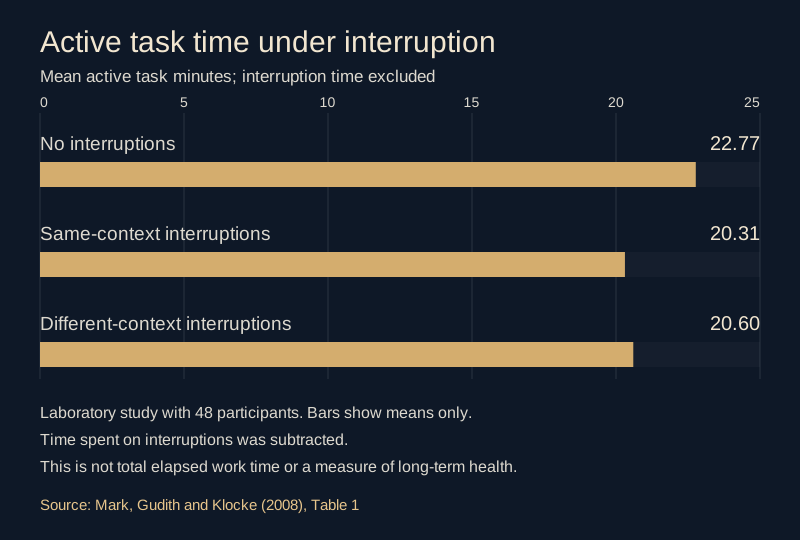
Figure 1. Mean active task time, excluding interruption time: 22.77 minutes without interruptions, 20.31 with same-context interruptions, and 20.60 with different-context interruptions. This laboratory comparison does not measure total elapsed work time or long-term health.
The result makes room for an uncomfortable possibility in ordinary work. People may try to protect delivery by hurrying. A report can arrive on time because someone compressed the remaining work into a tighter interval. The deadline is met, so the arrangement appears to have succeeded.
Consider an office that gives an employee a document due at five and adds several requests during the day. The employee skips a planned pause, writes faster, and submits at five. A manager who sees only the submission time may conclude that the additional requests were harmless.
Perhaps they were. Perhaps the document was easier than expected. Or perhaps the employee absorbed the pressure by working in a way that is unpleasant and difficult to sustain. The timestamp cannot tell us which account is true.
This is an argument about what we should measure, not a diagnosis of the employee. Ask what had to change for the work to remain on schedule. Was another commitment dropped? Was a colleague pulled away? Did the person use their evening? Did they shorten a part that needed more thought? These questions make the apparent success easier to interpret.
We should be wary of celebrating resilience when we mean that a person has hidden the cost from us. Being able to cope with an occasional difficult day is valuable. Arranging every day on the assumption that people will somehow cope is poor design.
At home, the same concealment can occur. Dinner arrives on time because one person rushed through preparation while answering questions and solving transport problems. Other people see dinner. They may not see the running calculation that delivered it. Sharing a task requires learning what surrounds it, including the interruptions that have been folded into the performance.
A person can be productive and still have good reasons to want the day changed.
Tired does not mean empty
After such a day, it is tempting to explain the feeling with a fuel gauge. The mind has used up its supply. The tank is empty. Refill it and continue.
The picture is simple. The science is less settled. A large preregistered project involving 36 laboratories and 3,531 participants tested a prominent version of the idea that prior self-control depletes a general resource. Its findings weakened strong claims about that effect.[6] This does not show that demanding work cannot tire us. It shows that a popular explanation should not be treated as a settled account of every tired afternoon.
We can take fatigue seriously without pretending to know the amount of a substance left in someone’s head.
An exhausted person may need sleep or rest. A person may also be hungry, worried, bored, overloaded, or trying to work under conditions that make each step needlessly difficult. Several of these can be true at once. Naming every difficulty depletion can make us overlook the part we could change.
Suppose two forms ask for the same information in different orders. You have to move between them, checking which version is current. The work is tiring in part because the design keeps asking you to reconstruct the relation. A clearer form would not make the mind limitless. It would stop spending effort on an avoidable problem.
Motivation matters too, but it is not a license to blame. A person who can stay absorbed in a favorite activity may struggle with a task whose purpose is unclear or whose next step is uncertain. That contrast tells us something about the circumstances. It does not prove that every difficulty can be cured by wanting success more intensely.
Sometimes you can make the purpose clearer. You are entering these figures so that someone can see whether the project can afford to continue. Sometimes you can reduce the friction. Put the relevant records together before beginning. Sometimes the task is simply tedious and still necessary. Honest planning can include that fact instead of demanding an inspiring relationship with every spreadsheet.
A useful day will contain tasks you do not love. It need not contain a theory that your dislike is a moral defect.
Looking focused
There is a theater of concentration. The serious face. The still body. The declaration that you are in a state of deep work. These may accompany real attention. They may also accompany an elaborate argument inside your head about why you cannot begin.
The task gives a better test than the pose. Can you follow what another person is saying? Can you explain the paragraph you just read? Can you identify the next step without starting the whole investigation again?
A person may think well while walking, or while making a rough sketch, or while speaking an idea aloud. Another may need stillness. We do not need to rank these outward forms as though one were the official uniform of the mind. We need to ask whether the activity supports the work and whether it creates problems for someone sharing the space.
This also helps separate sustained attention from sheer tension. Clenching harder is not always a way of understanding more. If you are rereading a sentence and failing to see its structure, writing a simpler version may help more than another stern command to concentrate. The change gives the thought a different form to work with.
There are also tasks for which broad awareness is part of doing well. Hosting a gathering, teaching a group, or walking through a busy station involves noticing changes outside one narrow target. A day should not be judged by how closely it resembles uninterrupted reading. Different activities ask attention to do different jobs.
Trouble begins when the demands conflict and nobody acknowledges the conflict. You cannot listen closely to one person while promising equal attention to every message that might arrive. You can arrange turns. You can designate an exception. You can pause the conversation if something truly requires you. Pretending that all claims can receive the same attention at once makes a promise you are poorly placed to keep.
Leaving work in a state you can find
We often imagine a productive interval as a rectangle on a calendar. The interval begins, we work, it ends. In practice, there is work around the rectangle.
At the beginning, you locate the material, remember the aim, and work out what has changed. At the end, you may need to preserve the state in which you are leaving things. If you give the entire interval to visible output, these transitions still have to occur somewhere. Often they are paid for by the next activity.
Suppose a forty-minute interval is available. You spend the first part recovering the problem, make some progress, and work until the final second. Later, you face the same recovery again. Now imagine using the last minute to record what has been settled and what should happen next. You have produced a minute less of immediate output. You may have left a more usable starting point.
That is a practical proposal, not a claim that every minute of note-taking yields a measured return. Sometimes a task leaves its own record. Sometimes the next step is obvious. Sometimes you must leave immediately. Use the aid where there is something worth preserving.
There is particular value in recording the reason behind an unusual choice. The next person, including your future self, may otherwise spend time undoing a sensible decision because its purpose has vanished. “Kept this row because it covers the unpaid balance” can prevent another round of detective work. A file that stores the answer but loses the reason can still be difficult to use.
Now return to the cabinet. The drawing is open. The correct panel is in place. The small bag of remaining fittings is beside it. You can leave, attend to something else, and return to a job that tells you what it needs.
This is a modest form of freedom: not the freedom to live without interruption, but the freedom to come back without having to begin your life again.
The spoon on the counter taught us something. Memory is part of the task. So is the way we leave the counter.
Sources and notes
[1] Erik M. Altmann, J. Gregory Trafton, and David Z. Hambrick, “Momentary Interruptions Can Derail the Train of Thought,” Journal of Experimental Psychology: General 143 (2014), 215–226. The ratios concern sequence errors on post-interruption trials relative to baseline, not general error rates. Paper
[2] Andrew Huberman, “ADHD & How Anyone Can Improve Their Focus,” Huberman Lab, September 13, 2021, discussion beginning around 2:09:40. The passage here credits a framing observation about many contexts on one screen; it does not adopt the episode’s medical recommendations or causal ADHD claims. Episode and transcript
[3] Stephen Monsell, “Task Switching,” Trends in Cognitive Sciences 7 (2003), 134–140. A synthesis of experimental task-switching research; the effects vary with task and preparation. Review
[4] Sophie Leroy, “Why Is It So Hard to Do My Work? The Challenge of Attention Residue When Switching Between Work Tasks,” Organizational Behavior and Human Decision Processes 109 (2009), 168–181. The paper investigates prior-task carryover and subsequent performance; the invoice and note examples are original illustrations. Paper
[5] Gloria Mark, Daniela Gudith, and Ulrich Klocke, “The Cost of Interrupted Work: More Speed and Stress,” CHI 2008, tables 1 and 3. Mostly university-student sample; simulated email work. Figure 1 independently plots reported means, not a copied research figure. Author-hosted paper
[6] Kathleen D. Vohs and colleagues, “A Multisite Preregistered Paradigmatic Test of the Ego-Depletion Effect,” Psychological Science 32 (2021), 1566–1581. A test of a particular resource-depletion paradigm, not proof that sustained effort, inadequate sleep, or demanding conditions cannot cause fatigue. Paper